
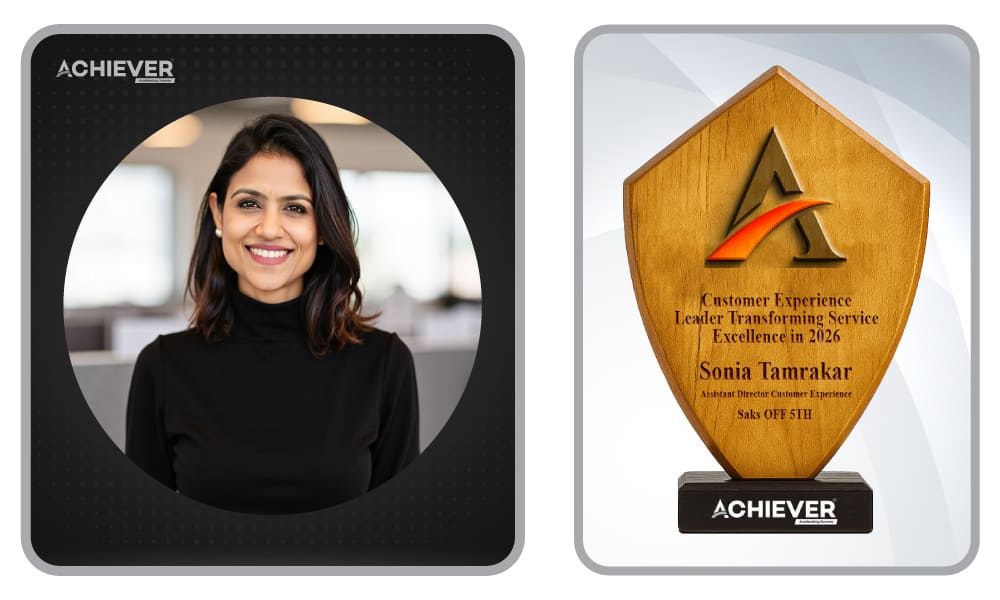
Featured Leader – Sonia Tamrakar
Role– Assistant Director Customer Experience, Sawgrass at Saks OFF 5TH
- Could you briefly take us through your professional journey and the key experiences that shaped you as a customer experience and business leader?
My professional journey spans more than 20 years across hospitality, enterprise services, retail, and customer experience. I began my career in the hospitality industry, where I learned that service excellence is fundamentally about understanding people, anticipating needs, and creating meaningful experiences.
My experience with JW Marriott was particularly formative. Working in luxury hospitality and guest relations taught me the importance of attention to detail, consistency, empathy, and leadership presence. I later moved into enterprise services with G4S, where I developed experience in strategic account management, client relationships, sales, training, and service delivery across large organizations.
My transition into retail with Macy’s and, most recently, Saks OFF 5TH allowed me to bring those experiences together in highly dynamic customer-facing environments. Across these roles, I have increasingly focused on the connection between employee experience and customer experience.
Today, I see myself as a customer experience leader but as a practitioner-scholar who uses operational experience, data, and research to understand how organizations can create better experiences for both employees and customers.
- What inspired you to build your career around customer experience, service excellence, and employee engagement?
What inspired me most was recognizing early in my career that customers remember how an organization makes them feel, but employees are often the people creating that feeling.
In hospitality, retail, and enterprise services, I found that the quality of a customer interaction was often influenced by what happened behind the scenes. When employees felt supported, prepared, respected, and motivated, they were more likely to deliver exceptional service.
That observation became a central theme throughout my career. I became increasingly interested in the question: What can leaders do to create an environment where employees genuinely want to deliver their best?
That question eventually became more than a professional interest. It became the foundation of my doctoral research, in which I am examining Experienced Appreciation in Social Interactions and its relationship to employee engagement and customer satisfaction.
- What are you currently focused on in your role at Saks OFF 5TH, and how are you working to improve customer satisfaction and service excellence?
In my current role as Assistant Director of Customer Experience at Saks OFF 5TH, I focus on strengthening the connection between frontline behaviors, customer expectations, and business outcomes.
One important part of my role is using data to understand customer experience. I have implemented Power BI dashboards to monitor customer experience and employee engagement metrics, including NPS and other engagement indicators. This allows us to move beyond anecdotal feedback and use measurable information to identify opportunities.
I also lead cross-functional customer-experience initiatives from planning through execution. That involves understanding the customer journey, aligning stakeholders, identifying gaps, and translating strategy into actions that frontline teams can implement. At the same time, customer experience cannot be improved through metrics alone. We have to help employees understand what those metrics mean and provide the coaching, tools, and support they need to influence the customer experience.
- Could you share one achievement or initiative from your current journey that best reflects your leadership approach and its impact on customers or employees?
One initiative that reflects my leadership approach has been the development and use of Power BI dashboards to bring customer experience and employee engagement data into operational conversations.
For me, the value of a dashboard is not simply the number on the screen. The real value is what leaders do with the information.
I focus on turning data into conversations: What is happening? Why might it be happening? What behaviors are influencing the result? Moreover, what can we do differently?
This approach has helped create greater visibility around customer experience and employee engagement and has supported more focused conversations with stakeholders. It also reflects how I lead: I believe in combining data with empathy and frontline insight. A strong leader needs to understand the numbers, but also understand the people behind those numbers.
- How do you believe employee engagement, recognition, and leadership influence the quality of customer experience?
There is a very strong relationship between employee experience and customer experience. An engaged employee is more likely to be attentive, proactive, resilient, and willing to go beyond the basic requirements of a role. However, engagement does not happen in isolation. Leadership, organizational culture, and everyday interactions all contribute to how employees experience their workplace.
Recognition is particularly important because it communicates that an employee’s contribution is seen and valued. It does not always have to be financial. Sometimes, a sincere acknowledgment, meaningful feedback, or appreciation from a leader can have a powerful effect.
This idea is central to my doctoral research. My dissertation examines Experienced Appreciation in Social Interactions (EA-SI) and its relationship to employee engagement and customer satisfaction.
My research is essentially exploring something I have observed throughout my professional career: when employees feel valued, how does that experience influence their engagement—and ultimately the experience they provide to customers?
- With AI, personalization, and data transforming customer experience, what trends do you believe will shape the future of service excellence?
The combination of technology and human connection will define the future of customer experience.
AI and data will allow organizations to understand customers more deeply, personalize interactions, predict needs, and resolve problems more efficiently. Those capabilities will become increasingly important.
However, technology will not eliminate the need for human empathy. In fact, the more routine interactions become automated, the more valuable meaningful human interactions will be.
The organizations that succeed will be those that use AI to empower employees rather than replace human interaction. Data should help frontline employees make better decisions, understand customers more effectively, and provide more personalized service.
Employee experience analytics will also become increasingly important. Organizations will need to understand not only what customers are experiencing, but also what employees are experiencing, because the two are closely connected.
- As you continue your doctoral journey and professional growth, what are your key goals and aspirations for the next stage of your career?
My immediate academic goal is to complete my DBA at National Louis University, with my dissertation defense anticipated in December 2026.
My research focuses on Experienced Appreciation in Social Interactions, employee engagement, and customer satisfaction. I want to continue developing this work beyond my dissertation and contribute to the academic conversation around employee experience, organizational behavior, service management, and customer experience.
Professionally, my goal is to continue growing as a practitioner-scholar. I want to bring together rigorous research and real-world organizational experience to address problems that matter to both scholars and business leaders.
Ultimately, I want to build a career that allows me to contribute through research, teaching, leadership, and thought leadership. I am particularly interested in helping organizations understand that employee engagement and customer experience should not be treated as separate priorities. They are interconnected parts of organizational performance.
- What advice would you like to share with young professionals and aspiring women leaders who want to build a successful career in customer experience and leadership?
My first piece of advice is to stay curious. Do not limit yourself to the responsibilities written in your job description. Learn how the entire organization works, understand the customer, understand the employee, and learn how decisions are made.
Second, build your credibility through both results and relationships. Technical skills and performance matter, but leadership is ultimately about people. Your ability to listen, communicate, build trust, and bring people together will become increasingly important as you advance.
Third, do not be afraid to reinvent yourself. My own career has moved across hospitality, enterprise services, retail, customer experience, and now doctoral research. Each transition built on what came before it.
Moreover, to aspiring women leaders, do not wait until you feel completely ready. Take the opportunity, learn along the way, and make your voice heard. Your experience has value. Your perspective has value. Moreover, your leadership does not have to look like anyone else’s.
Finally, invest in yourself continuously. Build your professional expertise, but also develop your intellectual curiosity. For me, pursuing a doctorate after more than two decades in industry has been a reminder that learning does not have an expiration date.
Success is not necessarily about reaching one particular title. It is about continuing to grow, creating value for others, and having the courage to pursue the next chapter.


