
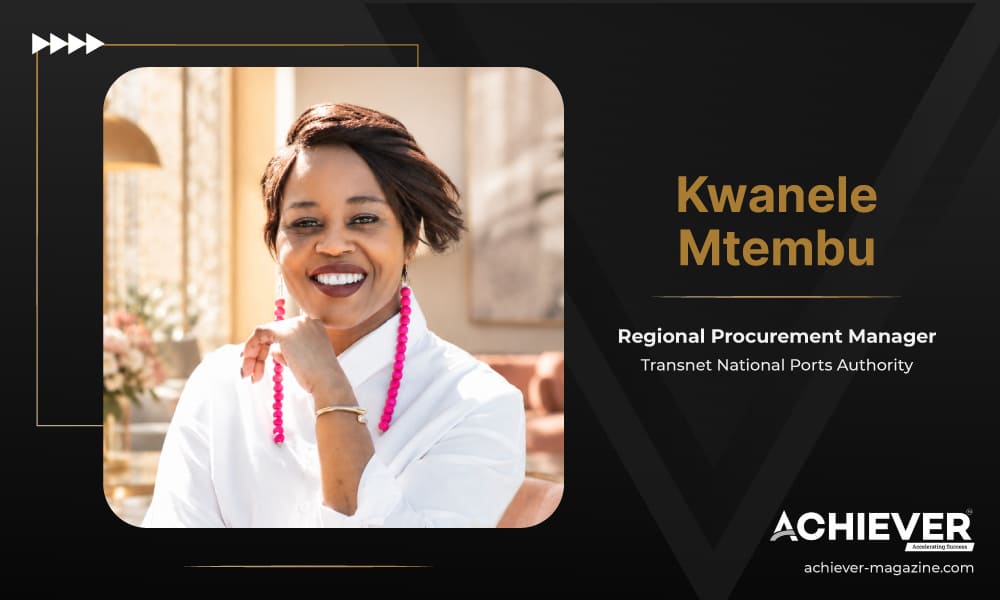
Driving Strategic Impact Through Procurement Excellence: The Inspiring Journey of Kwanele Mtembu
Redefining Procurement as a Strategic Force
In today’s rapidly evolving business landscape, procurement has moved far beyond its traditional perception as a transactional or administrative function. It has emerged as a critical driver of organizational strategy, resilience, and long-term value creation. Among the leaders shaping this transformation is Kwanele Mtembu, whose journey reflects both determination and a deep commitment to redefining the role of procurement in modern enterprises.
As Regional Procurement Manager at Transnet National Ports Authority in South Africa’s Eastern Cape, Kwanele stands at the intersection of strategy, governance, and operational excellence. Her story is not just one of professional success it is a narrative of adaptability, purpose, and the courage to embrace unexpected opportunities.
A Journey Shaped by Purpose and Possibility
Kwanele Mtembu’s professional journey is a powerful example of how career paths often unfold in ways that are neither linear nor predictable. During her high school years, she envisioned a future in auditing, a goal that naturally led her to pursue a Bachelor of Commerce in Accounting. Like many of her peers, she initially aligned her ambitions with traditional accounting pathways, including Chartered Accountancy.
However, even during her academic years, there was a growing curiosity within her—a desire to explore beyond conventional roles and understand the broader dynamics of commerce. This curiosity drew her toward cost accounting, a discipline that offered a more analytical and strategic lens into business operations.
A defining turning point came early in her career when she joined a local municipality as a financial management intern. Structural limitations within the organization disrupted her initial plans to pursue cost accounting. Yet, what could have been a setback became a moment of redirection.
During a rotational placement in 2004, Kwanele was introduced to a newly established supply chain management unit. Working closely with the Senior Manager, she gained exposure to every stage of the procurement lifecycle from supplier registration to transactional execution and strategic sourcing.
This experience fundamentally changed her perspective.
What stood out was the intellectual depth of procurement. Unlike rigid accounting processes, procurement demanded adaptability, market awareness, and strategic thinking. Each commodity required a tailored approach, informed by risk, technical requirements, and organizational priorities. There was no universal template only thoughtful, context-driven solutions.
Recognizing the potential of this field, Kwanele made a decisive shift. She pursued specialized studies in public procurement through the University of South Africa and further strengthened her expertise with advanced professional qualifications from the Chartered Institute of Procurement and Supply (CIPS), reaching Honours level training.
This combination of academic grounding and practical experience laid the foundation for a career defined by innovation and impact.
Leadership Rooted in Solutions, Not Processes
Kwanele’s leadership philosophy is both clear and compelling: procurement exists to solve problems, not simply to execute procedures.
She often describes supply chain management as the “engine” of an organization—an essential function that enables strategy to translate into action. Without it, even the most well-crafted plans remain static.
Over the years, her leadership approach has evolved from managing processes to empowering people. She has deliberately cultivated teams that think beyond checklists and templates, encouraging them to become proactive problem solvers.
Central to her philosophy are a few key principles:
- Deep listening to understand the needs of internal stakeholders
- A strong focus on delivering value and exceeding expectations
- Clear and consistent communication
- Accountability and timely execution
Rather than positioning procurement as a gatekeeper, Kwanele has worked to establish it as a trusted partner within the organization—one that drives outcomes while maintaining the highest standards of governance and integrity.
Leading Procurement Transformation at Scale
In her current role as Regional Procurement Manager for Transnet National Ports Authority, Kwanele provides strategic leadership across the Ports of East London, Ngqura, and Port Elizabeth.
Her responsibilities extend far beyond traditional procurement functions. She oversees capital expenditure procurement, works to reduce non-award rates, and actively promotes the inclusion of small, medium, and micro enterprises within the regional supply chain ecosystem.
At the core of her work is a commitment to shifting perceptions.
Procurement, she believes, should not be seen as a bottleneck, but as an enabler of progress. This belief is not merely theoretical it is reflected in tangible results.
One of the most notable achievements under her leadership was the successful delivery of three capital projects within just seven months at the Port of East London between 2023 and 2024. This milestone was particularly significant, as it was accomplished without compromising governance or compliance an outcome rarely seen at such speed within the supply chain function.
Through initiatives like these, Kwanele has demonstrated that efficiency and integrity are not mutually exclusive, but can coexist when procurement is approached strategically.
Aligning Procurement with Organizational Vision
A key aspect of Kwanele’s success lies in her ability to align procurement strategies with broader organizational goals.
She emphasizes that procurement cannot operate in isolation. Instead, it must be deeply integrated into the organization’s corporate strategy. At Transnet National Ports Authority, this alignment is achieved by anchoring supply chain priorities within the corporate plan.
By identifying systemic challenges and strategic imperatives, Kwanele ensures that procurement initiatives directly contribute to organizational success. This approach transforms procurement from a reactive function into a proactive force one that anticipates needs and delivers solutions aligned with long-term objectives.
Innovation as a Catalyst for Efficiency
Innovation plays a central role in Kwanele’s approach to procurement. Rather than relying on conventional methods, she has introduced a range of practices designed to improve efficiency, transparency, and resilience.
One of her early interventions involved the establishment of centralized communication channels across multiple ports. This initiative strengthened coordination and ensured business continuity for all transactions, particularly in complex operational environments.
She also introduced project-specific procurement strategies, including:
- Multiple award frameworks
- Split tendering models
- Standby supplier arrangements
These strategies have enabled greater flexibility, reduced risk, and improved delivery timelines.
A standout example of innovation under her leadership was the multi-port procurement of fire and emergency vehicles. By diversifying the awarding approach, she was able to mitigate risks and accelerate implementation.
Perhaps the most transformative achievement has been the significant reduction in procurement lead times. While industry norms often range between six to eight months, Kwanele’s interventions have reduced this to as little as 30 days in critical scenarios.
This was clearly demonstrated during the urgent reinstatement of tanker berth operations in Port Elizabeth following infrastructure damage. Her team’s swift action ensured uninterrupted fuel supply ahead of peak demand an outcome with far-reaching economic implications.
These accomplishments have not only improved operational efficiency but have also earned recognition through multiple awards since 2023.
Overcoming Challenges with Strategic Mindset
Like any transformative leader, Kwanele’s journey has not been without challenges.
One of the most significant obstacles she faced was driving change in environments where foundational procurement practices were inconsistent. Long lead times, fragmented processes, and a reliance on linear workflows created inefficiencies that hindered progress.
Rather than accepting these limitations, she took a systematic approach to change. By analyzing root causes and introducing parallel processing methods, she was able to streamline operations and improve outcomes.
Another challenge involved shifting mindsets within teams.
Many procurement professionals are accustomed to a template-driven approach, focusing on compliance rather than strategy. Kwanele is working to change this perspective, encouraging her teams to think critically and adapt documentation to specific contexts.
She also reinforced the importance of governance frameworks, not as rigid rules, but as dynamic guides that support informed decision-making.
By fostering a culture of continuous learning and accountability, she has significantly reduced audit findings for the Central Region Ports that she supports and strengthened overall performance.
Advancing Diversity in Procurement Leadership
The procurement industry has historically faced challenges in achieving gender balance, particularly at senior levels. However, Kwanele has witnessed and contributed to meaningful progress in this area.
Today, women are increasingly represented in leadership roles, professional forums, and executive positions within supply chain management. This shift is not only a matter of representation but also one of impact.
Diverse perspectives bring richer insights, better decision-making, and more inclusive outcomes. Kwanele’s own leadership journey serves as an inspiration for women aspiring to enter and excel in the field.
Empowering the Next Generation of Women Leaders
For aspiring women professionals, Kwanele offers advice that is both practical and empowering.
She encourages them to move beyond the perception of procurement as a rule-bound function and instead embrace its strategic potential. While governance and compliance are essential, they should not limit innovation or critical thinking.
Her message is clear: procurement is about understanding the entire supply chain and crafting solutions that deliver value efficiently, ethically, and sustainably.
Confidence, curiosity, and a willingness to challenge conventional thinking are key attributes for success.
Embedding Ethics and Sustainability
In an era where ethical practices and sustainability are paramount, Kwanele has made these principles central to her work.
At Transnet National Ports Authority, strong governance partnerships ensure that procurement processes are transparent, accountable, and aligned with organizational values. The governance, monitoring, and compliance function plays an active advisory role, supporting informed decision-making.
Kwanele also emphasizes ownership within her teams, encouraging individuals to take responsibility for their actions within established frameworks.
By promoting ethical awareness and openly addressing lessons from misconduct cases, she has helped build a culture of integrity that underpins all procurement activities.
The Future of Procurement: Trends to Watch
Looking ahead, Kwanele identifies several trends that will shape the future of procurement over the next three to five years.
Technology, particularly artificial intelligence, is set to play a transformative role, enhancing both planning and execution. Integrated procurement strategies aligned with corporate objectives will become increasingly important, enabling organizations to respond more effectively to complex challenges.
Collaboration between public and private sectors is also expected to grow, fostering innovative solutions and improving efficiency in large-scale procurement initiatives.
These trends underscore the need for procurement leaders to remain agile, forward-thinking, and open to change.
Staying Motivated in a Demanding Role
Despite the demands of her role, Kwanele remains deeply motivated by the opportunity to create meaningful impact.
Her passion lies in addressing systemic inefficiencies and implementing solutions that deliver tangible value. Equally fulfilling is her commitment to developing high-performing teams and expanding their strategic capabilities.
Maintaining balance, however, requires discipline. By focusing on priorities and managing her time effectively, she is able to sustain performance while navigating the complexities of her responsibilities.
A Legacy of Impact and Empowerment
Being recognized among The Most Admired Women Leaders in Procurement to Watch in 2026 is both a milestone and a reflection of Kwanele’s contributions to the field.
For her, the true measure of success lies in the legacy she leaves behind.
She envisions a future where procurement professionals fully understand and articulate the value they bring to their organizations. By developing future leaders who can think strategically and lead with confidence, she aims to elevate the entire profession.
Ultimately, her goal is to create a ripple effect one where empowered individuals go on to build their own legacies, driving excellence across industries.
Closing Thoughts: Redefining Procurement, One Leader at a Time
Kwanele Mtembu’s journey is a compelling reminder that leadership is not defined by titles, but by impact. Through her work, she has challenged traditional perceptions of procurement, transforming it into a dynamic and strategic function that drives organizational success. Her ability to combine governance with innovation, and efficiency with integrity, sets her apart as a leader to watch.
As the world of procurement continues to evolve, voices like hers will play a crucial role in shaping its future.
And in doing so, she is not only advancing her organization but also inspiring a new generation of leaders to see procurement not as a process, but as a powerful platform for change.


