
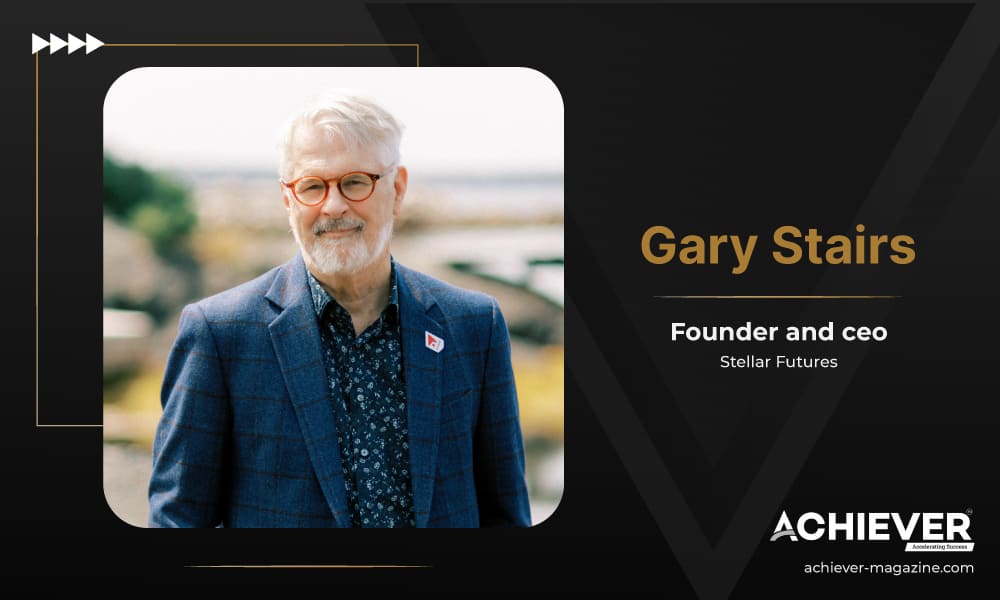
Gary Stairs: Building an Early-Warning System for Canada’s Working Coast
After five decades in public safety, digital learning and organizational leadership, the founder of Stellar Futures is bringing a preparedness mindset to Canada’s working harbours.
“Every Canadian working harbour deserves to anticipate tomorrow’s risks before they become tomorrow’s losses.”
GARY STAIRS, FOUNDER AND CEO, STELLAR FUTURES
In the spring of 1973, as floodwaters from the Saint John River rose in Fredericton, New Brunswick, Gary Stairs managed the registration of evacuees. He was at the beginning of his career, but the experience left him with an enduring lesson: in an emergency, trusted information delivered at the right moment can change the outcome.
More than 50 years later, that lesson has found a new setting. Stairs is the founder and CEO of Stellar Futures Inc., a Nova Scotia company working to make harbours, boats and workers safer. Its focus is infrastructure that is economically essential, locally managed and increasingly exposed to aging assets, severe weather and climate change.
A Career Built Around Preparedness
Stairs spent 13 years with the New Brunswick Emergency Measures Organization, where preparedness had to be translated into plans, communications and public action. He later helped lead the development and implementation of New Brunswick’s 911 system, and advanced emergency public communications. He also worked with the Office of the Fire Marshal, Emergency Preparedness Canada and on cross-border accords with Maine Emergency Management and FEMA Region 1. In 2012, his public service was recognized with the Queen Elizabeth II Diamond Jubilee Medal.
Through work connected with NB Power’s Point Lepreau Nuclear Generating Station, Stairs helped develop off-site emergency plans and public communication systems for an event no one wanted to face but everyone had to be ready for. He led Canada’s first advance distribution of potassium iodide tablets for a nuclear emergency, placing protection in residents’ hands before it was urgently needed. The experience reinforced a principle that still guides him: preparedness must be practical, understandable and in place before a crisis.
His academic work deepened that interest in risk and public decision-making. Stairs earned a master’s degree in communication studies from Simon Fraser University, received a President’s Research Award, completed environmental law coursework at the University of British Columbia and wrote his thesis on Fundy tidal power. Communications, environmental policy and operations became interconnected parts of how he understood preparedness.
As VP Marketing on LearnStream’s leadership team in the late ‘90s, Gary Stairs helped triple employment while revenue grew fivefold—from approximately $2.5 million to $12.5 million. LearnStream ultimately grew to more than 150 developers and became one of Atlantic Canada’s pioneering e-learning companies. For several decades, Stairs was also a shareholder in Goose Lane Editions, the long-established Canadian literary publisher, where he served in several board positions and contributed strategic perspectives to its development. He is now Director Emeritus. Together, these experiences taught him to measure ambition against execution and results.
In 2002, Stairs founded Red Hot Learning Inc. to create executive learning, compliance programs and strategic forums for organizations confronting complex change. The company developed digital learning for governments, United Nations organizations and international corporations, including Daimler AG and Mercedes-Benz operations in Europe and Asia, with deployments in 23 languages. Red Hot Learning showed him how specialized knowledge could become a practical, scalable tool across organizations, cultures and borders—experience that now informs Stellar Futures.
The Missing Picture at the Harbour
A working harbour can appear simple from the road: a wharf, several buildings and boats moving with the seasons. In practice, it is a connected operating environment. Workers, vessels, electrical systems, fuel, weather, water levels, inspections and maintenance decisions interact every day. A failure in one part can affect safety, landings, income and an entire community.
The information needed to understand that system often exists, but not as one usable picture. Inspection reports may sit in one file, photographs in another and maintenance histories in spreadsheets. Weather and water observations arrive through separate services. Some of the most valuable intelligence remains in the memories of harbour managers and fish harvesters.
Stellar Futures is being built to connect those fragments. Harbour Atlas™ creates a structured, living record of assets, condition, inspections, photographs, maintenance needs, local observations and evidence gaps. It is intended to help harbour authorities see priorities, plan work and prepare stronger cases for capital investment.
Harbour Sentinel™ adds the active layer: weather and water information, sensors, cameras, vessel data, alerts and decision support. Atlas helps answer what needs attention and why. Sentinel helps answer what is changing now and whether people should act. Together, they move the harbour from scattered records toward a shared operating picture.
Building the Evidence
Stellar has moved beyond a broad coastal AI idea. The company has developed the architecture for Harbour Atlas and Harbour Sentinel and begun populating Atlas with structured information for a growing group of South Shore small craft harbours. Its demonstration model starts with five harbours, can expand to 20 and ultimately reach 46 across the South Shore–St. Margarets Bay region.
In 2025, Stellar Futures received $70,000 through winning Amazon Web Services Canada’s and PREDICTif’s national commercial pitch competition to advance its technical development. For Stellar, the next test is now practical: can a focused demonstration improve decisions, identify risk earlier and produce evidence of reduced losses or downtime? That is the standard Stairs wants the company to meet.
He uses three questions to keep the work grounded: Does it make people safer? Does it help communities make better decisions? Can it create measurable and lasting value? The questions also impose discipline. Stellar is not trying to solve every coastal problem at once; it is building the evidence needed to earn wider adoption.
A Market Moving Toward Resilience
The timing is consequential. Canada’s Spring Economic Update 2026 proposes $957.8 million over five years, beginning in 2026–27, for the Small Craft Harbours Program, beyond its approximately $90-million annual budget. The federal government says the work will support repair, modernization and climate resilience using the latest climate projections. Major investment will require credible information about asset condition, urgency, priorities and results—the evidence gap Harbour Atlas is designed to address.
Nova Scotia’s Seafood Sector Strategy 2026-2029 points in the same direction. It calls for an efficient, resilient and technology-enabled industry supported by innovation, expanded coastal monitoring, integrated data and practical climate-risk tools. Harbour Atlas aligns with the longer planning horizon; Harbour Sentinel aligns with the operational need to recognize deteriorating conditions early.
For Stairs, climate adaptation is not an abstract aspiration. It means understanding which structures and operations are exposed, deciding which repairs should come first, recognizing when conditions are becoming unsafe and determining whether resilience investments are working. It also means respecting the observations of people who know a harbour through every season and storm.
The same capabilities could matter to insurers. Severe weather insured losses across Canada totalled $37 billion from 2016 through 2025, nearly three times the previous decade. Insurers increasingly need dependable, location-specific information about physical climate risk. Stairs sees a potential role for Stellar in loss prevention, risk assessment and event documentation—provided demonstrations show measurable reductions in damage, downtime or uncertainty.
An Ecosystem, Not a Solo Act
Stairs is quick to place the work in a larger ecosystem. Co-founders Gayle Grin and John Ross, alongside Stellar’s developers and advisers, contribute design, software, policy and technical expertise. Harbour users, governments, researchers, insurers and coastal communities will bring knowledge the company cannot manufacture on its own.
Stellar also collaborates with i-Valley Canada, a Canadian not-for-profit that helps rural communities develop high-speed networks and smart applications of technology. The relationship brings experience in community connectivity, data and partnership-building while extending intelligent-community thinking to the working coast.
QUOTATION — BARRY GANDER’S APPROVED
“Stellar Futures is extending intelligent-community thinking to Canada’s working coast. By bringing local knowledge, infrastructure data and early warning together, it is developing a practical way for smaller harbours to plan investment, adapt to climate risk and better protect the people and livelihoods that depend on them.”
BARRY GANDER, CO-FOUNDER, i-VALLEY CANADA
That community dimension matters. Technology introduced into a harbour must be trusted by the people expected to use it. Data ownership, privacy, cybersecurity and the limitations of automated recommendations must be addressed openly. Artificial intelligence can reveal patterns, but it should strengthen human judgment rather than displace it. Local experience may explain what a sensor alone cannot.
A Coastwide Ambition
Stairs envisions an intelligent working coast spanning Canada’s three oceans. In that future, a small harbour authority could access useful risk intelligence without the staff or systems of a major port. Local observations could strengthen regional understanding, while patterns across many harbours could help direct investment toward the greatest need.
The ambition is larger than building another technology company. Stairs wants to help establish a stronger standard of care for working harbours—one that anticipates risk, respects local knowledge and ensures smaller coastal communities are not left behind by technological change.
The thread running from the Fredericton flood of 1973 to Stellar Futures is preparedness. Prediction has value only when it helps someone make a better decision. For Gary Stairs, that is the purpose of Harbour Atlas and Harbour Sentinel: giving the people who depend on Canada’s working harbours more time, stronger evidence and a better chance to act before risk becomes loss.


