
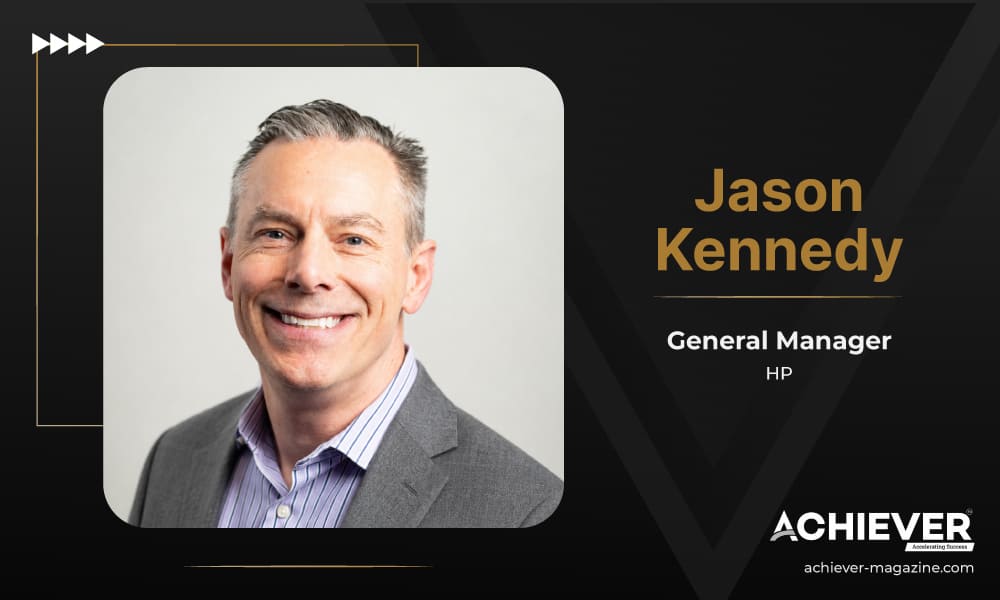
Jason Kennedy: Driving Responsible Innovation and Sustainable Growth in the Hybrid AI Era
A Leadership Journey Built on Systems Thinking
For more than three decades, Jason Kennedy has built his leadership journey around a simple but powerful understanding: every business decision creates consequences that extend beyond a single function or immediate result. With a foundation in industrial engineering, environmental systems, and business strategy, Kennedy developed a systems-oriented approach that has shaped the way he thinks about technology, customers, people, and the planet. His career has taken him through complex technology environments where innovation had to move beyond ideas and become something scalable, commercially meaningful, and capable of creating lasting value.
During his tenure at Intel, Kennedy worked across new product categories and brands, global strategic alliances, client and data center portfolios, and AI-enabled computing. These experiences gave him a practical understanding of what it takes to move innovation from concept to market adoption. Today, at HP Inc., as GM / Senior Director of OneHP Sustainable Portfolio Strategy, he applies that experience to a different but closely connected challenge: making sustainability a meaningful business driver. For Kennedy, leadership is not simply about achieving immediate results. It is about aligning people around meaningful outcomes, learning from setbacks, and helping others become more capable throughout the journey. His philosophy is captured in his belief that the leaders who shape the future will be those who connect technology, people, and purpose to create innovations that perform and endure.
Making Sustainability a Driver of Business Value
Kennedy’s decision to join HP was influenced by the opportunity to work at the intersection of engineering excellence, global reach, innovation, and responsible impact. What distinguishes his current focus is his belief that sustainability should not operate as a separate corporate initiative. Instead, it should be integrated into the way products, software, services, and customer experiences are designed and delivered. His role involves connecting strategic vision with execution across functions and translating complex sustainability priorities into clear and measurable customer value.
That approach is particularly relevant as businesses enter the Hybrid AI era. Kennedy sees an opportunity for HP to demonstrate that performance and responsibility do not have to be competing ambitions. His focus includes aligning portfolio roadmaps, customer engagement, disclosures, and go-to-market priorities around outcomes such as efficiency, resilience, trust, and long-term value. Rather than relying on broad statements about responsible business, he emphasizes practical outcomes that customers can understand and organizations can measure. In his view, the strongest innovations are those that improve people’s lives and work today while also considering their impact on tomorrow.
Turning Innovation into Measurable Impact
At the heart of Kennedy’s leadership agenda are three closely connected priorities: embedding sustainable design into the portfolio, converting strategy into market momentum, and using AI and digital workflows to simplify complexity. His work spans customer and partner engagement across field, channel, retail, and alliance-led environments, allowing strategy to connect directly with market needs. At HP, programs supported by his leadership have extended across more than 550 annual events and influenced over $33.2 billion in revenue, demonstrating the scale at which he operates.
Technology is only one part of the impact Kennedy seeks to create. Through HP’s partnership with WWF and the “Together, We Grow” initiative, more than 660,000 acres of threatened forests and associated biodiversity have been conserved. For Kennedy, figures such as these are meaningful because they demonstrate that responsible business can create tangible outcomes. At the same time, he is focused on applying AI to improve how teams work. Agentic AI workflows have been deployed to enhance inquiry and deal productivity, illustrating his broader belief that digital transformation should remove friction and help people focus their efforts where they create the greatest value. His objective is not innovation for its own sake, but a repeatable system in which responsible design, customer trust, and cross-functional execution reinforce sustainable growth.
Building Teams That Can Lead Through Change
Kennedy approaches transformation by first creating clarity. In environments where technology, markets, and customer expectations are changing rapidly, people need to understand what is changing, why it matters, and how their individual responsibilities contribute to the larger objective. His leadership approach begins with shared purpose, followed by measurable priorities, clear accountability, and transparent decision-making. He believes that urgency must be balanced with empathy because people do not all adopt change at the same pace.
This philosophy has shaped the way he works with direct and matrixed teams across functions, cultures, and time zones. Kennedy considers alignment an ongoing leadership practice rather than a one-time communication exercise. He encourages people to question assumptions, experiment thoughtfully, and contribute ideas rather than simply execute instructions. His approach to innovation starts with understanding the human or business problem being solved and identifying the evidence that would demonstrate meaningful impact. By removing unnecessary barriers and distributing ownership, he aims to create teams where innovation becomes a shared capability. This is also why he describes himself as a talent multiplier. For him, the most lasting achievement is not one successful initiative, but a team capable of repeatedly turning curiosity into customer value while developing the next generation of leaders.
Shaping the Future Through Hybrid AI and Responsible Leadership
Looking ahead, Kennedy sees Hybrid AI as one of the forces that will significantly influence how organizations operate and how products create value. Intelligence will increasingly be distributed across devices, the edge, and the cloud, with workloads positioned according to requirements such as performance, latency, security, economics, and user experience. He also sees growing potential in physical AI and on-device intelligence, particularly in areas such as asset utilization, predictive maintenance, energy efficiency, and decision-making closer to the point of action.
Yet Kennedy believes the defining question will not simply be what AI can do, but how responsibly and inclusively organizations choose to apply it. He argues that future leaders will need to connect AI strategy with customer experience, resilience, sustainability, and human needs. This perspective also shapes his definition of visionary leadership. For Kennedy, vision requires curiosity, courage, humility, and the discipline to turn ambitious ideas into measurable progress. It also requires the ability to connect areas that are often treated separately, including technology, business, people, ecosystems, and societal expectations.
His vision for the future extends beyond business performance. Kennedy hopes to contribute to a technology landscape where innovation becomes more intelligent and powerful while responsibility becomes increasingly embedded in its design and deployment. His personal measure of legacy is equally people-focused: helping others think bigger, move with greater confidence, and lead with purpose. He wants the leaders he mentors to create opportunities for others and recognize that the way results are achieved can be just as important as the results themselves. In that sense, his leadership philosophy comes down to a clear principle: responsible innovation is not a limitation on growth, but a pathway toward growth that earns trust and has the potential to endure.


