
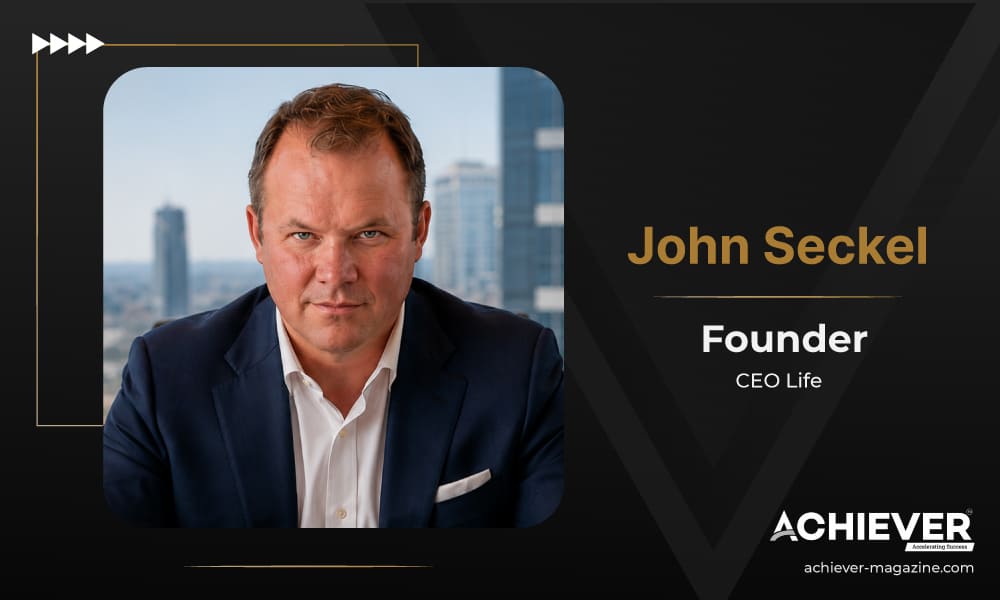
From Building Businesses to Building People
The Visionary Journey of John Seckel
John Seckel has always been a builder. Early in his career, he was drawn to the challenge of taking an idea, seeing what it could become, and bringing together the people, strategy, marketing, and execution required to make it real. His professional journey has taken him from corporate leadership to entrepreneurship, through building, scaling, and selling businesses, and ultimately to founding CEO Life. Along the way, he has experienced both sides of entrepreneurship: growth and success, but also setbacks, lawsuits, missed payroll, tax challenges, businesses that had to close, and periods when the future was far from certain. Those experiences shaped him more than the victories did. They taught him resilience, accountability, and the importance of remaining calm when others are looking to you for confidence. They also taught him that leadership is not about appearing to have every answer. It is about continuing to move forward, making difficult decisions, learning quickly, and taking responsibility for the people who have trusted you.
Today, Seckel’s greatest strength is his ability to see opportunity where very little exists yet and turn that vision into something tangible. He has learned how to build brands, create demand, bring people together, and take ideas from zero to meaningful revenue quickly. But he has also learned that business is only part of the story. Ultimately, the people you build with and the lives you impact are what give the work meaning.
A Foundation in Leadership
Seckel’s understanding of leadership began taking shape during his time at Northeastern University. Being placed in leadership environments while he was still developing professionally taught him that leadership is something earned through action. He discovered that he was most energized when creating, organizing people around a goal, and challenging conventional ways of doing things. Recognition for his entrepreneurial potential was meaningful, but it reinforced something he already felt internally: he was wired to build. Those early experiences taught him to become comfortable taking responsibility, making decisions without perfect information, and believing in an outcome before everyone else could see it. That philosophy continues to influence the way he leads today. Seckel believes leaders should give people ownership, encourage independent thinking, and create environments where ambitious ideas are welcomed. Great leaders do not need to be the smartest person in every room; they need to create rooms where talented people can do extraordinary work together.
He began his professional career at Wachovia, where he became one of the company’s youngest Vice Presidents. His corporate experience provided a foundation in professionalism, financial discipline, sales, relationships, and accountability, while also teaching him the importance of systems. Entrepreneurs naturally want to move quickly, but sustainable growth requires processes, measurements, and accountability. That lesson continues to influence every company he builds. Perhaps most importantly, his corporate career reinforced the value of trust. Whether working with a client, employee, investor, or partner, people want to know that you will do what you say you are going to do. Markets change and strategies evolve, but trust remains one of the most valuable currencies in business.
Eventually, Seckel realized that he did not simply want to participate in someone else’s system. He wanted to create the system himself. He had always been drawn to ideas—brands, business models, marketing opportunities, and new ways to solve problems. Entrepreneurship gave him the freedom to take those ideas from imagination to execution and connect the outcome directly to his own decisions, creativity, and willingness to take risks. Once he experienced what it felt like to create something from nothing—to see customers buy it, employees believe in it, and a business develop momentum—he knew that building companies was what he was meant to do.
Turning Ideas into Opportunity
Launching and selling several businesses taught Seckel an important lesson: a great idea is not enough. The market has to care. He looks for meaningful problems, markets where people are already spending money, and opportunities where the existing experience can be substantially improved. From there, he considers the brand, customer acquisition, economics, and scalability. Speed is also an important part of his approach. Rather than spending years perfecting an idea that may not have a market, he prefers to get close to customers, test the premise, and allow real-world feedback to shape the company. As he puts it, entrepreneurs should be obsessed with the mission and the customer, but flexible about the path.
That mindset begins with a simple question: Why does this have to work this way? Many opportunities are hidden inside frustrating experiences that people have simply accepted as normal. By questioning those experiences and understanding what customers truly value, Seckel looks for ways to create something substantially better. Innovation, he believes, does not always mean inventing something the world has never seen. Sometimes it means taking several things that already exist and combining them in a way that creates a completely different experience. This ability to move from a blank page to a name, brand, offer, marketing strategy, sales process, and operating business has become one of his defining entrepreneurial strengths.
Building CEO Life
CEO Life emerged from another problem Seckel recognized—one that had less to do with business models and more to do with human connection. Success can actually make meaningful relationships more difficult to find. CEOs, entrepreneurs, and business leaders may be surrounded by people, yet still lack environments where they can build genuine relationships with peers who understand the responsibilities, pressures, and opportunities that come with leadership. Seckel wanted to build something deeper than a traditional networking organization, so CEO Life was designed around business, relationships, extraordinary experiences, and impact. The vision was to create a community where leaders could meet people they could build businesses with, travel with, learn from, become friends with, and make a difference alongside.
Today, the mission is to unite and connect 50,000 leaders physically, digitally, and globally for business growth, meaningful relationships, extraordinary events, and impactful community giving. CEO Life creates these connections through local chapters, curated events, business conversations, social experiences, travel, and philanthropic initiatives. The goal is not simply to exchange business cards. Repeated interactions create familiarity, familiarity creates trust, and trust creates opportunities that cannot be manufactured through a single introduction. Some members may find customers or strategic partners; others may find investors, advisors, friendships, or simply people they enjoy experiencing life with. The value is intentionally broader than business because leaders are human beings before they are titles.
Philanthropy is equally important to Seckel. A successful community, in his view, should have an impact beyond itself by mobilizing the influence, resources, and generosity of its members to help the communities around them. It is this combination of business, personal relationships, shared experiences, and giving back that distinguishes the vision for CEO Life.
The Power of Trust
Seckel believes relationships have become even more important as technology continues to transform business. Information is abundant, and artificial intelligence is making knowledge and capabilities increasingly accessible. What remains difficult to replicate is trust. A trusted relationship can compress years into a conversation. It can create an introduction, solve a problem, open a market, prevent an expensive mistake, or lead to a partnership that neither person could have built alone.
For that reason, Seckel believes the leaders who thrive in the future will be exceptional relationship builders. A strong network is not measured by how many people you know, but by the quality of the relationships you have built and the amount of trust that exists within them. In an increasingly digital business environment, genuine human connection may become one of the greatest competitive advantages a leader can have.
The Adversity Behind the Success
Behind Seckel’s entrepreneurial success is also a period of significant adversity—one that fundamentally changed his understanding of resilience. There was a stretch when several parts of his personal and professional life seemed to be breaking at the same time. He faced business pressure, lawsuits, missed payroll, tax problems, the possibility of foreclosure, and enormous strain in his personal life. There were moments when quitting would have been understandable. He chose not to.
Instead, he learned to stay calm above the water while kicking furiously underneath it. He put fear and anxiety into work, exercise, progress, and being present for his children. That period taught him that resilience is not a motivational phrase. It is what happens when there is no easy answer and you decide to show up again tomorrow anyway. It also changed his relationship with failure. A difficult chapter is not necessarily evidence that the story is over. Sometimes, the chapter where everything appears to be falling apart is the chapter where you are becoming the person capable of building everything that comes next. That perspective has made Seckel a better entrepreneur, but perhaps more importantly, a more empathetic human being.
Leadership Through Change
These experiences continue to shape the principles Seckel uses to lead. First, take responsibility. When you are the leader, the outcome ultimately belongs to you. Second, move. He would rather make a thoughtful decision, learn from the market, and adjust than allow fear of being wrong to create paralysis. Third, surround yourself with people who are better than you in important areas and give them room to perform. Fourth, tell the truth, especially when the truth is uncomfortable, because problems become exponentially more expensive when leaders refuse to confront reality. Finally, remember that businesses are built by humans. Numbers matter tremendously, but culture, belief, relationships, and purpose determine whether talented people want to stay and build something meaningful together.
As technology and markets continue to evolve, Seckel believes adaptability is equally important. Leaders have to become comfortable being students again and again. What worked five years ago may not work today, and what works today may be irrelevant several years from now. Leaders need to stay close to customers, understand emerging technology, measure what is actually happening in their businesses, and remain willing to challenge their own assumptions.
Artificial intelligence is a perfect example. Rather than seeing AI simply as a threat, Seckel views it as a powerful tool that can make small teams more capable, improve decision-making, accelerate creativity, and allow entrepreneurs to build at speeds that previously required far more capital and infrastructure. But adaptability does not mean chasing every trend. Values and mission can remain consistent while methods evolve continuously. The challenge is knowing the difference.
Investing in Humans
Looking ahead, Seckel sees an opportunity for CEO Life that extends well beyond adding more chapters or members. He wants to build one of the most meaningful communities of leaders in the world by continuing to expand into important markets, strengthening the member experience, investing in technology, and creating opportunities for members to build relationships across cities and countries.
At the same time, Seckel is increasingly focused on a personal philosophy he calls “Invest in Humans.” Sometimes that means capital. Sometimes it means mentorship, relationships, strategy, or building a company together. For Seckel, the next chapter of his career will not be measured only by what he builds himself. It will also be measured by what becomes possible for other people because their paths crossed with his.
That philosophy represents a natural evolution of everything he has learned throughout his career. Building businesses taught him how to create value. Adversity taught him resilience. Leadership taught him the importance of trust. CEO Life has given him a platform to bring those lessons together through human connection.
A Vision That Continues
Being recognized among The 10 Most Influential Visionary Leaders Driving Change in 2026 is meaningful to Seckel because his journey has not been a straight line. Awards capture a moment, but they rarely show the nights when an entrepreneur is scared, the mistakes, the businesses that did not work, the relationships that did not survive, or the moments when the future feels uncertain. Seckel knows those moments well, which is why he views this recognition not as a finish line, but as validation that resilience, curiosity, and a willingness to keep building can eventually compound into something meaningful.
His message to the next generation of leaders is simple: do not allow someone else’s inability to see your vision to become evidence that your vision is wrong. Listen to smart people. Learn from criticism. Study the numbers. Be willing to change your mind. But if you have done those things and still believe deeply in what you are building, have the courage to keep going.
You will be wrong sometimes. You will fail sometimes. There may be seasons when the people around you question your decisions. Keep learning. Build something that matters. Treat people well. Own your mistakes. Stay curious. Become incredibly difficult to break.
And when you eventually have the resources, experience, and relationships to change someone else’s trajectory, invest in that human.
For John Seckel, success is becoming less about what one person can accomplish alone and more about what becomes possible when people connect, believe in one another, and build together. His journey from corporate leadership and entrepreneurship to the creation of CEO Life reflects that evolution.
The builder is still building. But the vision has grown beyond businesses. It is now about creating a community where ambitious people can connect, grow, contribute, and help one another create opportunities that may not have existed before.
And perhaps that is the most enduring lesson of Seckel’s journey: the greatest things we build are not always companies. Sometimes, they are relationships, communities, and possibilities that continue to grow long after we have helped create them.


