
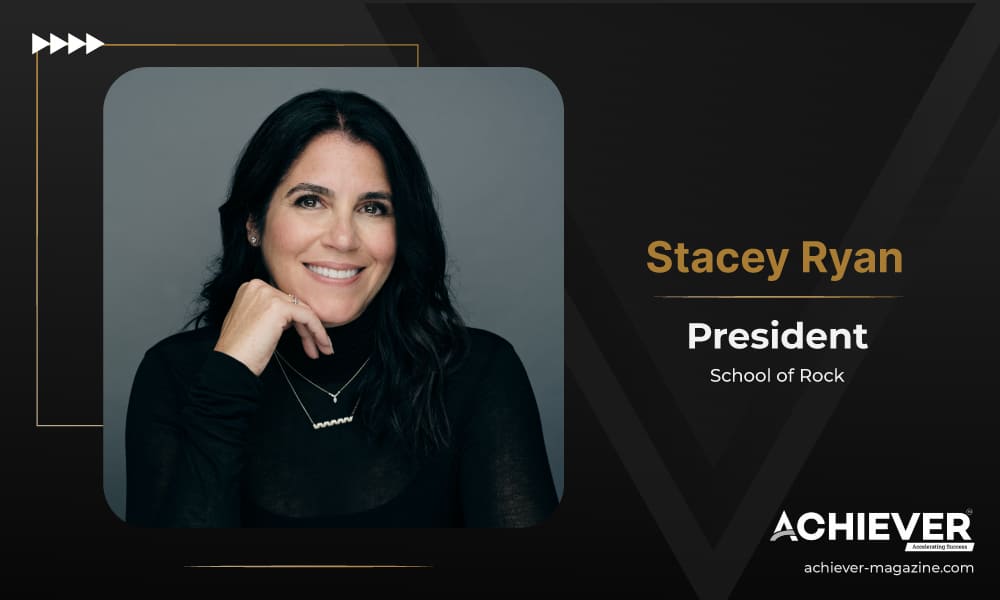
Stacey Ryan: Leading a Global Community Through Music
As organizations grow and scale, there’s a natural tension between expansion and staying personal. Growth can challenge us to be more intentional about what made the work meaningful in the first place. Global brands must continually reconnect with their “why,” systems should serve people—not replace them—and education, especially arts education, is at its best when heart and humanity remain at the center alongside strong operations.
Stacey Ryan stepped into leadership at precisely that inflection point. As President of School of Rock, she brings a deeply held conviction shaped by that period: that as the organization evolves, hope, purpose, and impact must remain central—because the influence we have on young lives truly matters. From the beginning, Stacey believed in the transformative power of music not merely as a curriculum, but as a force that shapes confidence, belonging, and identity. Under her leadership, School of Rock has grown globally while staying anchored with what matters most: ensuring every student feels seen, connected, and capable of thriving both on stage and in life. While the brand’s patented curriculum remains the foundation, Stacey has guided how the experience is delivered, supported, and evolved, adapting alongside students and educators without losing emotional depth or human connection.
Her work balances operational excellence with long-term vision, culture, and impact. As the organization expands into new markets, Stacey remains steadfast in ensuring that every school experience feels personal, consistent, and transformative no matter the geography. For her, School of Rock is not just about building successful businesses, but about helping students, franchisees, and staff become the best versions of themselves.
What might look like a career milestone is, in truth, something deeper: an evolution in leadership. A belief that when education is done right when music, purpose, and people stay at the center hope doesn’t fade under pressure. It grows louder.
A Journey of Purpose, Courage, and Transformation
Stacey Ryan’s journey to School of Rock began with a search for purpose, authenticity, and a calling to enrich the lives of young people through education. Raised in New Jersey and a graduate of Rutgers University, she spent more than two decades building a career in education-focused organizations. Along the way, she held senior leadership roles at companies such as Huntington Learning Centers and The Goddard School, where she developed a deep respect for the transformative power of education, strong operations, and people-first leadership. Working closely with franchise owners and multi-unit teams, she saw firsthand how purpose-driven businesses can be scaled while still making a meaningful impact on communities.
A defining moment in her career came when she made the difficult decision to leave a previous executive role after realizing the culture no longer aligned with her values. Confronted with a toxic and sexist environment and told she would be “more successful if she wore lipstick”, Stacey chose integrity over title. Walking away without a backup plan was a risk, but one that ultimately became the most important decision of her professional life.
That leap of faith led her to School of Rock, where the mission immediately resonated. From her first interaction with the brand, it was clear that School of Rock was not simply teaching music, it was changing lives. She witnessed young people discovering confidence, connection, and purpose through performance, and felt a strong pull to be part of that work. Much like the students who step onto the stage for the first time, unsure but determined, Stacey leaned in and found a new calling.
Today, as President of School of Rock, Stacey leads a global organization serving tens of thousands of students across hundreds of schools worldwide. What drives her daily is seeing the profound impact music education can have not just on developing musicians, but in helping young people find their voice, build resilience, and feel a sense of belonging. For many students and families, the experience is genuinely life changing.
Her commitment to authenticity and empowerment extends beyond School of Rock. Stacey is the founder of FrontWomen, an organization dedicated to supporting women navigating outdated norms and expectations in corporate environments and helping them lead with confidence and authenticity— resources she wishes had existed earlier in her own career.
At School of Rock, Stacey brings together purpose, resilience, and a belief in the transformative power of education. Under her leadership, the brand remains deeply committed to its mission: to enrich lives through performance-based music education. Students don’t just learn instruments; they learn collaboration, communication, risk-taking, and accountability. Standing on stage builds resilience and self-expression skills that endure long after graduation.
The impact of this work is now supported by data. In an independent study commissioned by School of Rock and conducted with the support of Sound Diplomacy, more than 1,400 parents of current students were surveyed. Of those parents,96.2% reported increased confidence in their child, 95.9% observed improved teamwork and collaboration skills, 80.4% reported their child was happier, and 79.5% noted an improved ability to express emotions or use music as a coping strategy since joining School of Rock. These findings affirm that the program’s influence extends far beyond music instruction and helps shape confident, capable human beings.
Through its global franchise network, School of Rock delivers this impact at scale, empowering local owners to serve as leaders within their communities while maintaining a consistent, mission-driven experience worldwide. As the organization continues to grow, Stacey’s focus remains unwavering: expanding access to music education, supporting franchise partners, and ensuring every student who walks through the doors can shine, connect, belong, and thrive both on stage and in life.
Scaling a Global Brand While Staying True to Purpose, People, and Performance
Throughout her time at School of Rock, Stacey has led the organization through periods of significant growth, change, and challenge experiences that have defined the milestones she is most proud of.
One of the most pivotal moments came during the uncertainty of the COVID-19 pandemic, when Stacey was serving as the brand’s Chief Operating Officer. During this time, the Operations team played a critical role in helping schools adapt quickly by developing safety protocols, reimagining program delivery, supporting virtual and hybrid models, and providing real-time guidance to franchisees navigating constantly shifting conditions. While the period was deeply challenging, it ultimately revealed the strength of the School of Rock system. Franchisees, instructors, and support teams came together with resilience, creativity, and a shared commitment to students demonstrating just how connected and powerful the community truly is.
Stacey is also especially proud of the work done to strengthen and scale the operations function. By building the right infrastructure, talent, and processes, she helped establish a foundation for sustainable domestic and international growth. Over seven years, she led the expansion of the Operations team from just two people to twenty-two teams she credits for delivering meaningful, consistent support to both franchisees and company-owned locations.
Her transition from COO to President marked another meaningful milestone. It represented not only a personal career achievement, but an evolution in how the brand is led balancing operational excellence with long-term vision, culture, and impact. Becoming part of the small 21% of women represented in C-suite roles in the United States was a moment of pride, paired with a deep sense of responsibility to help create pathways for future women leaders. That responsibility became the catalyst for launching FrontWomen, an initiative rooted in mentorship, visibility, and building a stronger pipeline of women in leadership.
Launching School of Rock’s Social Impact Study stands out as another defining achievement. Being able to quantify and validate the organization’s long-held belief that School of Rock meaningfully builds confidence, belonging, and happiness in young people provided powerful, data-driven credibility to the brand’s mission.
On a personal level, Stacey was honored as a SheRocks Champion Award winner at the 11th annual event sponsored by The Women’s International Music Network (WiMN). She is also proud to have co-founded FrontWomen with a colleague, creating a community dedicated to supporting, connecting, and elevating women leaders across industries. Both experiences reinforced her belief in the importance of representation, mentorship, and using leadership to open doors for other values she brings to her work every day.
Under Stacey’s leadership, School of Rock has evolved thoughtfully alongside changes in music education, technology, and student learning styles while staying true to its core. The brand’s unique and patented curriculum remains the foundation, but how the experience is delivered, supported, and enhanced continues to adapt with students and educators.
From an educational standpoint, School of Rock meets students where they are. Instruction is personalized, genre-inclusive, and centered on the music students love, while remaining grounded in strong musical fundamentals. Programs are designed to support diverse learning styles through a blend of group rehearsals, one-on-one lessons, and real-world performance experience creating an engaging, inclusive, and confidence-building environment.
Technology now serves as a powerful complement to the in-school experience. Investments in digital systems enhance consistency, visibility, and connection across the global network, while preserving the human element that defines School of Rock. Digital practice tools and learning resources help keep students, parents, and staff aligned and supported.
The model also reflects how today’s students learn and engage. Performance provides purpose, collaboration fosters accountability and belonging and being part of a band builds identity and motivation. Students thrive when they feel connected to peers, instructors, and the music itself.
At the same time, School of Rock remains deeply committed to the emotional and developmental outcomes of music education. Findings from the recent Social Impact Study confirm that the approach is working, with parents reporting meaningful gains in confidence, teamwork, happiness, and belonging. These outcomes continue to guide how organization evolves, ensuring that as education and technology change, School of Rock delivers an experience that remains relevant, human, and transformative.
More Than Music Education—A Platform for Belonging and Growth
One of the most exciting ways School of Rock is shaping the future of the brand is through innovative partnerships that provide students with performance opportunities they simply wouldn’t find elsewhere. Grounded in the belief that real-world performance is one of the most powerful teachers, these experiences continue to set School of Rock apart.
Through its partnership with Summerfest, one of the largest and most iconic music festivals in the world, students are given the rare opportunity to perform on a major festival stage in front of live audiences. Stepping onto a stage of that scale transformation builds confidence, professionalism, and pride, while reinforcing that their hard work truly matters. Collaborations with artists such as Frank Zummo, drummer for Sum 41, further deepen this impact by giving students direct access to working professional musicians. Through performance and mentorship, students gain insight into the realities of the music industry and what’s possible through discipline, creativity, and perseverance.
In addition, partnerships with organizations like Loyal to the Craft have opened doors for students to perform in authentic, high-profile music environments such as the Vans Warped Tour. These experiences go far beyond traditional recitals, immersing students in energy, expectations, and accountability of professional-level performance.
Equally important is School of Rock’s Social Impact initiative, which has helped clearly to articulate and now prove that the organization is far more than a music school. An independent study surveying more than 1,400 parents provides data-backed validation of outcomes seen every day: increased confidence, stronger teamwork skills, greater happiness, and a deeper sense of belonging. This research continues to shape how the organization communicates its mission, advocates for music education, and guides future program development across the system.
School of Rock’s community culture is built intentionally and grounded in core values of collaboration, optimism, inclusion, and the belief that music can positively transform young lives. That culture begins with franchisees, the leaders of local schools who set the tone for how students, instructors, and staff show up each day. Franchisees are empowered through ongoing training, coaching, shared resources, and a strong peer network, recognizing that supported leadership creates strong, connected communities.
For local staff and instructors, empowerment starts with trust and shared purpose. Instructors are musicians, educators, and mentors, and they are given the tools, training, and autonomy needed to build meaningful relationships with students and bring the curriculum to life.
For students, empowerment comes from belonging to something larger than themselves. Being part of a band teaches collaboration, accountability, and mutual respect, while performance builds confidence and resilience. In a safe and inclusive environment, students are encouraged to support one another, step outside their comfort zones, and find their voice. School of Rock is not just teaching music it is helping students realize what they are capable of.
At every level, the culture is rooted in connection. Students learn alongside peers, instructors collaborate with one another, and franchisees share best practices across the global network. Through rehearsals, performances, training experiences, and shared milestones, a true sense of community is reinforced.
Ultimately, School of Rock cultivates empowerment by creating spaces where people feel safe to try, learn, and succeed together. When franchisees, instructors, and students feel supported and a sense of belonging, confidence follows and that is what makes the School of Rock community so distinctive.
Lessons in Leadership from a Moment That Changed Everything
One of the most defining challenges Stacey faced at School of Rock was navigating the COVID-19 pandemic. Even before the virus had spread beyond China, the leadership team came together to assess potential impacts on the business, franchisees, and the communities they served. They planned early, recognizing that the organization’s mission of enriching lives through music—would be more important than ever at a time when young people were losing connection, routine, and emotional support.
Almost overnight, School of Rock restructured its entire operating model. Step-by-step operational, educational, marketing, and IT resources were developed to help schools manage closures, virtual instruction, and safety protocols, with medical expertise guiding key decisions. By mid-March 2020, these changes had been rolled out system-wide, enabling schools to continue serving students while many organizations were still trying to understand the scope of the crisis.
Creativity and connection became central to the response. The organization launched Artist Sessions, Master Class programming, and live-streamed performance opportunities, ensuring students could continue to experience the power of belonging to a musical community. When schools were able to reopen, it was done thoughtfully with clear guidelines, transparency, and an unwavering commitment to safety.
From a leadership perspective, the pandemic became one of the most instructive periods of Stacey’s career. It reinforced the importance of acting early and decisively, even without perfect information. It underscored how transparency and consistency build trust during uncertainty. Most importantly, it affirmed that when leaders anchor themselves in empathy and purpose, people rise to meet extraordinary challenges. What could have been an impossible moment for a performance-based music education organization ultimately made School of Rock stronger, more connected, and more resilient lessons that continue to shape how Stacey leads today.
Her guidance moving forward is rooted in one principle: leaning into the unknown. Lean into the work, the discomfort, and the people around you.
Creative industries rarely follow a straight line, and success often looks very different from what is imagined at the start. Stacey believes real growth happens in moments of uncertainty whether it’s a young musician stepping onto a stage for the first time, an emerging leader finding their voice, or an entrepreneur building something from the ground up. Progress comes from showing up before you feel ready.
She emphasizes the importance of leaning into collaboration. Creative work is never done alone, and some of the most meaningful breakthroughs come from learning alongside others, listening deeply, and remaining open to feedback. The ability to work across styles, perspectives, and experiences is just as vital as raw talent.
Equally important is leaning into discipline as much as passion. Creativity flourishes when supported by consistency, practice, and accountability. The artists and leaders who endure are those who stay committed to their craft, even when inspiration is absent.
Finally, Stacey encourages leaning into purpose. Understanding why the work matters—not just what is being built creates resilience when challenges arise. When passion is tied to something larger than oneself, whether community, impact, or helping others find their voice, it becomes a sustaining force.
For Stacey, the message is clear: those willing to lean in won’t just build careers in creative industries, they’ll build something meaningful.
More Schools, More Voices, One Mission
Stacey envisions School of Rock continuing to expand globally while remaining deeply anchored to the mission that has guided the organization from the very beginning. Today, School of Rock proudly supports more than 430 schools across 17 countries, a global footprint that brings both momentum and responsibility. As the brand grows, her focus remains on ensuring that the experience inside every school regardless of market feels personal, consistent, and transformative.
She sees School of Rock further solidifying its position as being more than a music school. The recent Social Impact Study has provided data-backed proof of what the organization has long believed: that School of Rock builds confidence, teamwork, happiness, and a strong sense of belonging in young people. Over the next five years, Stacey is excited to deepen that impact and use both data and storytelling to elevate the role of music education in youth development and to advocate for creative education on a broader, global stage.
An even stronger, more empowered franchise network is also central to her vision. Through continued investment in training, technology, and support systems, franchisees will be equipped to lead thriving schools, build strong teams, and serve as trusted leaders in their communities. As the system grows, collaboration and knowledge-sharing will remain priorities, enabling owners to learn from one another and scale best practices efficiently.
What excites Stacey most about the future, however, is the people behind the numbers. Every new school represents more students finding their voice, more instructors mentoring the next generation, and more franchisees building meaningful, purpose-driven businesses. As long as the organization stays focused on changing lives through music, she believes School of Rock’s next chapter at an even greater global scale will be its most impactful yet.


