
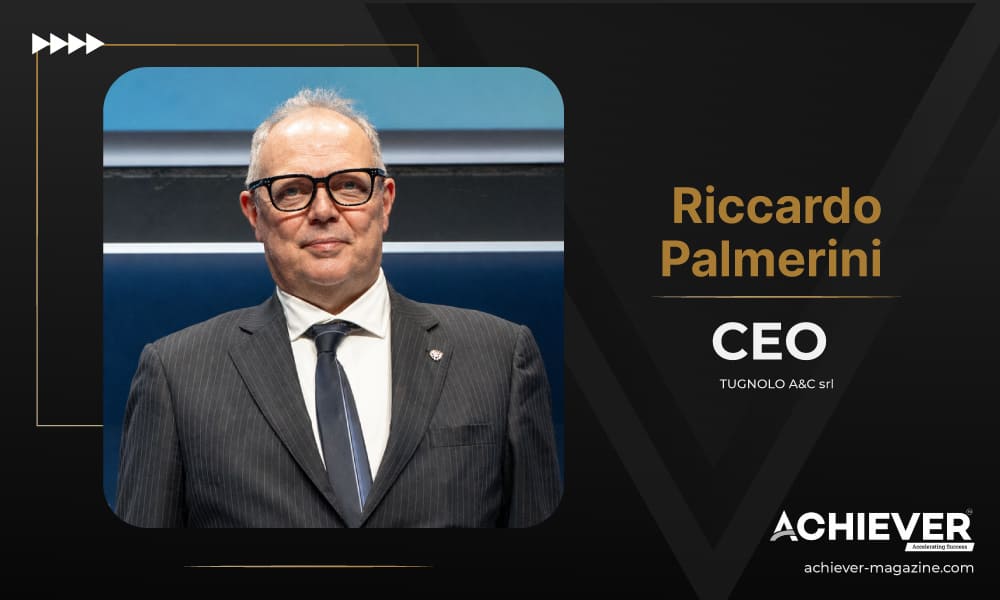
Riccardo Palmerini: The Work That Keeps You Alive
There is a certain stillness in the way Riccardo Palmerini speaks not the absence of energy, but the presence of conviction. It is the voice of someone who has learned that leadership is not about being the loudest in the room, but about being the most intentional. When he speaks about business, it does not sound like numbers or transactions. It sounds like responsibility. Like purpose. Like something deeply personal.
His journey as CEO of TUGNOLO A&C srl is not framed by titles or milestones alone, but by a philosophy that quietly reshapes everything it touches. In his world, success is not measured only by profit margins, but by the sense of ownership that lives within every individual in the organization. He believes that when people feel truly responsible for outcomes, they stop behaving like employees and start thinking like entrepreneurs proactive, invested, and driven not by instruction, but by intention.
Listening to him, one begins to understand that this mindset is not accidental. It is cultivated. It is built on a foundation where expectations are clear, goals are shared, and the pursuit of excellence is constant. For Riccardo, it is never about maintaining a level it is about sustaining growth, about honoring the journey that brought the company to where it is while continuously raising the bar for what it can become.
Yet what makes his voice stand out is the way it bridges business with humanity. He speaks thoughtfully about development, not as an abstract concept, but as something that shapes lives. Every project, every intervention, is approached with a simple but powerful belief: that spaces are not just built they are lived in. They carry stories, influence communities, and have the power to improve the quality of life for those who inhabit them. For him, real estate is never just about structures; it is about creating social contexts where people can thrive.
There is pride in his words when he speaks about his team not as a workforce, but as a collective of minds that have transformed the company into a center of excellence. Even disagreements, he notes, are not signs of division, but of commitment rooted in the shared desire to execute every mandate with precision and integrity.
And underlying it all is a vision that looks beyond the present. A belief in sustainability not as a trend, but as a responsibility. Those renewable resources, when used wisely, do more than preserve the environment they create opportunity, generate wealth, and strengthen the very fabric of the communities they serve.
To listen to Riccardo Palmerini is to hear more than a CEO. It is to hear someone who understands what it truly feels like to lead with clarity, with accountability, and with a quiet but unwavering passion for building something that lasts.
Building Growth Through Knowledge, Innovation, and Experience
Riccardo’s career has been shaped by an enduring curiosity and a constant drive to discover and learn. In every sector he has worked in, his first priority has always been to understand the underlying logic of stakeholders, the operational and market dynamics specific to that industry, and the regulatory frameworks that govern it. By nature, he embodies a balance between pragmatism and creativity pragmatism guiding him to fully comprehend the realities of the present, and creativity pushing him to explore new possibilities and solutions. As he often shared with the students, he had the privilege to teach, the moment one believes they have finished studying is, in truth, the moment real learning begins.
Over time, his professional path evolved from managing banking information systems to innovating them. This transition eventually led him to the other side of the spectrum developing new technologies, particularly in the fields of communication and innovation. Exploring these domains required a deep understanding of their rules and dynamics. Communication, closely linked with marketing, opened the door to continuous learning across new disciplines. At times, however, innovation moved faster than the market itself, reminding him of the importance of pragmatism: even the most advanced idea holds little value if the market is not ready to receive it.
Economics has consistently remained at the core of his work. His journey with European funds began as a recipient, later evolving into roles as a consultant and promoter. This naturally led him to support entrepreneurs in development projects. However, the impact of national and international crises reshaped demand, drawing him into the field of corporate crisis management an area where the human dimension proved to be just as critical as technical and financial expertise.
Throughout his journey, several influential theories and frameworks became foundational to his thinking and approach to business. Concepts such as Lateral Thinking, the Six Thinking Hats, the UN Agenda 2030, the Stiglitz-Sen-Fitoussi Report, and sustainability-based economic models deeply influenced his perspective. He came to view sustainability not as a cost, but as an opportunity one that can simultaneously generate business value and widespread well-being.
At a pivotal moment, he was approached by Tugnolo, whose ownership sought to guide the company toward new markets, moving beyond the trajectory established by its founders. This shift was not a rejection of the past, but a strategic search for emerging opportunities. Initially drawing on his pragmatic strengths, he identified the right technical and managerial talent to support this transition, strengthened relationships with financial partners, and established well-structured agreements with both clients and suppliers. Entering a market supported by favorable incentive measures outside the traditional frameworks present in Italy at the time he and his team adopted a low-profile approach, focusing on learning quickly and executing effectively.
In a relatively short period, they achieved remarkable results. By building an agile and efficient organizational structure one that mirrored the models of larger, established players they secured important certifications and recognition. More importantly, they consistently delivered outcomes that met and exceeded client expectations.
This evolution has been gradual, shaped by continuous research and learning. While every company must adhere to established economic, financial, and administrative principles, he recognizes that each market, sector, and region carries its own unique characteristics, cultural nuances, and relational dynamics. As a result, every step forward has been informed by accumulated experience, enriched by the exploration of new fields.
Over time, he has built what he describes as a “toolbox” of knowledge—one that continues to expand with each challenge encountered. These challenges have not always been easy. They have tested his resilience, pushed him to adapt, and, at times, forced him to confront his own limits. Yet through every stumble, he has continued to move forward learning, building, and strengthening his capacity to take on what comes next.
A Leadership Defined by Responsibility
Riccardo has been entrusted by the ownership with full responsibility for the company’s development a role that extends far beyond strategy into the very fabric of execution. From identifying and implementing market strategies to organizing and managing operations, he carries accountability at every level. The weight of this responsibility is not abstract; it is something he feels every day. He is responsible not only for meeting the expectations of ownership, but also for delivering results to the team that works alongside him, to clients who place their trust in the company, and to suppliers and partners who contribute to achieving shared objectives.
From the outset, the company has been shaped by a set of guiding principles that he not only embraced but instilled across the entire organization. While firmly rooted in the logic of sound management and administrative discipline, the company has remained open to exploring new solutions and unconventional pathways. Operating in traditionally conservative sectors where innovation is often limited to the product itself he chose instead to innovate the approach to the market and the philosophy behind every engagement.
At the core of this approach lies a simple yet transformative belief: every intervention must consider people. The company does not merely develop real estate it creates social contexts. Each project is designed to enhance the quality of life for those who live, work, and interact within these spaces, as well as for the broader communities they influence. To support this vision, the company integrates digital technologies extensively, often developing proprietary solutions that enable it to operate more effectively and distinctively. Yet, even as innovation drives progress, he remains deeply connected to his origins, ensuring that growth never comes at the cost of forgetting the journey that shaped it.
Structurally, the company has evolved to oversee the entire production chain within its sector—from analysis and design to supply and implementation. Looking ahead, further development will involve integrating additional production phases, particularly in waste management and the manufacturing of products for the energy systems sector. Strategic partnerships have also been established with key players in the thermal sector, spanning both domestic and industrial applications. Several major initiatives are on the horizon, focusing on innovative processes linked to ESCO activities and international expansion.
Underlying all of this is a broader vision of sustainability one that extends beyond physical structures to encompass the quality of life itself. He firmly believes that collaboration among market participants, viewed not as competitors but as partners, is essential to achieving meaningful progress. This philosophy aligns with the broader objectives outlined in global sustainability frameworks, and it is reinforced internally through the adoption of an Ethical and Professional Code, upheld across all relationships with clients, suppliers, and partners.
What ultimately distinguishes the company is its vision of the market and the way it engages with it. Rather than focusing solely on real estate transactions, it pursues a long-term strategy aimed at improving the social environments in which its projects exist. The production of energy from renewable sources is seen as a fundamental pillar not only to support international sustainability targets but also to meet the ambitious milestones set for 2030, 2035, and 2050.
In this context, the work being done today is not just about present outcomes. It is about contributing to objectives that affect the entire community helping to shape a future that, given the complexity and urgency of the sector, is already unfolding.
A Blueprint for Long-Term Value and Market Leadership
It is essential to understand that between 2020 and 2025, the Italian real estate market was profoundly influenced by extraordinary government measures known as the Superbonus. Under this framework, property owners were required to carry out energy efficiency and seismic retrofitting works, financed through state-backed tax credits provided certain conditions were met, including certified impact, quality assurance, and the involvement of qualified General Contractors capable of managing the entire process.
It was within this context that Tugnolo positioned itself strategically. Rather than rushing into the opportunity, the company entered the market with a measured and structured approach prioritizing management systems, organizational processes, contractual clarity, and financial coverage. In its initial phase, Tugnolo operated exclusively as a General Contractor, focusing on coordination and document verification for construction companies and professional firms. Over time, this role evolved, with the company gradually moving into direct on-site operations by recruiting skilled professionals from the market.
The year 2023 marked the peak of this cycle, as fiscal incentives reached their highest levels, resulting in exceptional performance. The following years, 2024 and 2025, continued to deliver strong outcomes, albeit with slightly lower absolute figures. Profitability, however, remained high, while the company began transitioning toward more traditional types of interventions, ensuring continuity beyond the incentive-driven phase.
Anticipating the gradual conclusion of these fiscal benefits, Tugnolo proactively established strategic partnerships within the financial sector. These collaborations enabled clients to access dedicated financing solutions bridging the gap between full reliance on tax incentives and conventional funding models. This approach not only strengthened market penetration but also enhanced revenue streams and fostered long-term relationships with both clients and financial institutions.
In parallel, the company launched an innovative startup focused on advanced technological development. This initiative resulted in the creation of a highly sophisticated platform based on artificial intelligence, capable of performing predictive analysis for renewable energy production and storage systems. From residential and industrial photovoltaic plants to large-scale utility projects and energy communities, the platform supports comprehensive project development. It integrates technical specifications, detailed financial planning including plant-level profit and loss analysis carbon savings calculations, and TEE certification metrics.
What distinguishes this solution is its ability to cross-reference data with historical weather patterns and energy cost trends, all tailored to the precise geolocation of each installation. This enables a level of accuracy and efficiency that significantly enhances both planning and execution.
The company is also expanding its technological capabilities into additional areas, including construction site safety, as well as preventive and predictive analysis of energy performance before and after building interventions. These tools, developed internally to optimize operational effectiveness, are subsequently commercialized through licensing agreements. Tugnolo embraces an open-market philosophy, recognizing that wider adoption of such technologies contributes to a more efficient and trustworthy industry. In a market of this scale, the opportunity for high-performing enterprises far exceeds the capacity of any single operator.
Digital infrastructure plays a central role in supporting these operations. All documentation is securely stored in the cloud, supported by two certified data centers dedicated to document management and administrative processes. A third data center, currently external but planned for internal integration, manages the company’s technical applications. All sites are interconnected via VPN, with network management handled by a leading national telecommunications provider. This robust digital ecosystem enables seamless operations allowing the company to function efficiently, securely, and in real time, regardless of location ultimately delivering a highly responsive and effective service to its clients.
A Structured Path Toward Sustainable Growth
Tugnolo has firmly aligned itself with the objectives of the United Nations 2030 Agenda, embedding sustainable economic models into its core operations. Among its key priorities this year is active involvement in major projects within the energy sector, driven by a clear belief: renewable energy is not only an environmental necessity but also a catalyst for stronger, more livable social environments. It creates spaces where people can work and live better, while simultaneously generating employment and economic value. Unlike traditional resources, renewable sources do not deplete the environment or the regions that sustain them. Instead, they offer a resilient business model one that can also help mitigate the impact of increasingly frequent global crises. Guided by the 17 Sustainable Development Goals and their 169 underlying targets, the company approaches its work with humility, yet with the conviction that even a small, consistent contribution can create meaningful impact.
The company’s evolution has been steady and deeply rooted in its history. Its origins date back to 1980, when Annibale founded the business as a sole proprietorship. A decade later, his daughter Letizia joined and began modernizing operations, which at the time focused on industrial waste recovery and disposal. In 2019, a significant transition occurred when the company divested its main division to a leading industry group. By 2021, it had embarked on a new phase one defined by transformation, structure, and renewed direction. Central to this shift was the establishment of a robust management and organizational framework.
Despite this evolution, the company has preserved its family-oriented spirit. This is reinforced through continuous investment in its people not only through technical training, but also through team-building initiatives, welfare programs, and the adoption of an Ethical and Professional Code. This code extends beyond internal teams to include partners, suppliers, and clients, shaping interactions and relationships across the entire ecosystem. While no framework can eliminate every challenge, it provides a shared standard of behavior that supports continuity, transparency, and trust. In such an environment, energy is directed toward growth and innovation, rather than conflict resolution.
This culture has delivered tangible results. One notable outcome is the company’s exceptionally high per capita profitability driven by a workforce that feels a deep sense of ownership. Each individual operates with an entrepreneurial mindset, taking initiative and responsibility in addressing challenges and driving outcomes.
Operating in a highly regulated environment has required constant adaptability. Frequent changes in legislation have made it essential for the company to remain agile and informed. Over time, the internal team has developed strong expertise across technical, administrative, and legal domains. While collaborations with major advisory firms have taken place, the company has always maintained a proactive approach actively contributing to regulatory interpretation and implementation rather than passively awaiting external guidance. This approach has transformed the organization into a center of excellence, a point of pride for its leadership.
Challenges do arise, particularly in the context of disputes. One of the complexities faced is the limited sector-specific expertise within adjudicating bodies, which can make it difficult to fully convey the nuances of highly specialized operations. However, such situations remain relatively rare compared to the overall volume of transactions. The company’s strong reputation, combined with a balanced approach of firmness and diplomacy, has consistently helped it navigate potential conflicts without significant disruption.
At the core of its operations lies a defining principle: every commitment must be seen through to completion. Even in complex or contentious situations, the company remains focused on fulfilling its mandate fully and correctly. Disagreements, when they occur, are addressed within this framework of responsibility and accountability. This unwavering commitment not only strengthens the company’s position in challenging circumstances but also reinforces trust among all stakeholders because, at its core, Tugnolo does not leave things unfinished.
Building Beyond Business
Riccardo’s advice to those approaching any venture is to interpret it through three distinct yet complementary principles. First, every enterprise must be built on fundamental management and organizational criteria that transcend any specific sector: financial discipline, structured operations, technical and managerial skills, and most importantly character. He places strong emphasis on attitudinal qualities, particularly when evaluating human resources, because while technical expertise can be taught, attitude cannot. It must be innate, embedded in a person’s DNA, just as it must be embedded in the culture of a company.
The second principle is deep sectoral understanding. He believes that true effectiveness comes from knowing not only the industry in which one operates, but also the markets that define it. This requires studying their logic, practices, technical frameworks, and regulatory systems, while also understanding the cultural and environmental contexts in which they exist. Every geography is different countries vary, cities differ, and even within cities, neighborhoods carry their own identity. The people who live and work in these contexts are shaped by those differences, and successful leadership requires the ability to recognize and internalize them.
The third principle is an open, adaptive mindset capable of out-of-the-box thinking. Building on a solid foundation of structure and knowledge, he emphasizes the need to look forward to anticipate the continuous evolution of society. A strong advocate of lateral thinking, he believes it is essential to shift perspectives, challenge conventional frameworks, and approach problems from new angles in order to remain relevant and effective. This, he clarifies, is not inconsistency or unpredictability, but vision firmly anchored in objectives while constantly striving to elevate standards.
He also expresses sincere gratitude for recognition received along the journey. For him, such acknowledgment is not a reflection of past achievements to be preserved for personal satisfaction, but rather a renewed responsibility. It represents a commitment to meet and exceed expectations moving forward. The goal is never to maintain a level already reached, but to sustain the growth that made it possible—both professionally and personally.
He hopes that the broader message of his journey, particularly for younger generations, is one of possibility. Even in an increasingly complex and conflict-driven global environment, development can still be built. Growth remains achievable, provided there is resilience, courage, and a willingness to face challenges with determination and a solution-oriented mindset.
He strongly believes that business does not need to be conducted at the expense of others. It is not about charity, but about creating systems in which value can be generated collectively. Economic growth, in his view, can be inclusive capable of expanding wealth even for those traditionally excluded or overlooked. This requires embracing new models of value creation, where resources are not depleted but multiplied, enabling shared progress rather than competition for scarcity.
This is not merely philosophical thinking, he notes, but a vision supported by economic theory and long-term strategic reasoning. It is a model that rejects short-term extraction in favor of generational investment one that does not exhaust resources within a few cycles, but instead builds foundations strong enough to benefit future ones.
The Reality Behind Achievement
Overall, at first glance especially when viewed from a position of recognition everything may appear simple. But it is not, and it never is. Achieving meaningful results, whether in daily life, business, sport, or any other field, requires the ability to endure hardship, disappointment, and sustained effort. Challenges are always more numerous than ready-made solutions, and progress is never effortless.
Riccardo believes that only those who have been tested those who carry scars that remain present in memory every day can truly grow and contribute to development. Results do not arrive on their own, and there are no shortcuts or “magic formulas.” In his view, it is only through sacrifice and the willingness to confront difficulty that success becomes possible, at any level.
For this reason, he emphasizes the importance of constant reinvention. One must have the courage to change, to begin again even when already occupying positions considered successful or optimal. Stability, in his perspective, can become a hidden risk. Remaining still, refusing evolution, is often the first step toward decline.
Growth, therefore, is not a moment it is a continuous discipline.


