
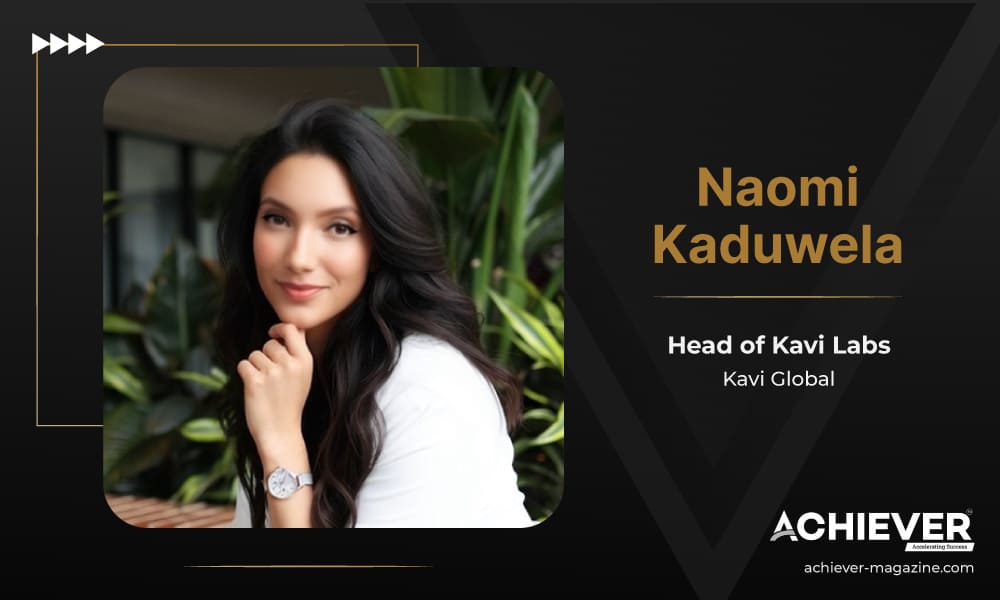
Naomi Kaduwela ARCHITECTING A BETTER TOMORROW: THE FUTURE OF HUMAN-CENTERED AI FOR GOOD
We now live in an era where conversational AI is no longer a novelty; it is the norm. Nations are experimenting with AI-assisted governance, corporations are appointing AI chiefs of staff, and intelligent systems are advising leaders with a speed and precision that outpace human decision-making. The age of automation has given way to something far more profound: an evolution in which AI doesn’t just execute tasks but actively guides, recommends, and even decides, faster, more reliably, and more optimally than ever before.
The democratization of models has transformed the landscape. Business users no longer need to code; generative and agentic tools can now build models themselves, continuously improving in ways that once seemed unimaginable. Yet with this extraordinary progress comes a pressing question: as artificial intelligence encroaches on the domain of human intelligence, what remains the role of the human?
Naomi Kaduwela, Head of Kavi Labs at Kavi Global, challenges us to confront this question head-on. Harnessing AI’s power for good requires more than technical brilliance; it demands responsibility. Every computation carries a cost, not just in energy and water, but in sustainability and ethics. The true measure of innovation is not how fast or how cost-effectively we can execute, but which problems we choose to solve.
In this new world, where execution is effortless and scale is instantaneous, leadership is being redefined. The winners will not be those who simply deploy AI, but those who humanize it: those who ensure that technology serves humanity’s deepest needs while unlocking its greatest potential.
AI and Automation: Reshaping Industry and Humanity
Beyond individual technologies, Naomi views AI and automation as catalysts for a broader transformation in how humans and machines interact. Rather than replacing human roles, these technologies are enabling a new era of augmentation, one in which human intelligence and machine capabilities work in tandem.
Across industries such as healthcare, transportation, manufacturing, finance, and education, this collaboration is becoming increasingly evident. AI systems are handling large-scale data processing, predictive analysis, and operational optimization, while humans contribute creativity, contextual understanding, and ethical judgment.
This evolving dynamic is giving rise to more intelligent and adaptive workplaces. From AI copilots that support decision-making to collaborative robotics in industrial environments, organizations are designing ecosystems where technology enhances human potential rather than limiting it.
However, realizing this potential requires more than technology adoption. It calls for a shift in leadership mindset, one that combines technical fluency with empathy and a strong focus on human-centered design. Leaders must create environments where teams feel empowered to work alongside intelligent systems while maintaining trust, transparency, and ethical responsibility.
In this new paradigm, work itself is being redefined. Roles are becoming more fluid, tasks more dynamic, and opportunities more expansive. AI is not only increasing efficiency but also making work more inclusive and accessible by reducing barriers and simplifying complexity.
For Naomi, the true impact of AI lies in its ability to unlock human potential. By automating routine processes and enhancing decision-making, it allows individuals to focus on what truly matters: innovation, creativity, and meaningful contribution.
As AI continues to evolve, it is not just reshaping industries; it is reshaping the very nature of work and humanity’s role within it.
The Last Mile of AI Challenge
We are living through a defining moment in enterprise transformation.
Across industries, organizations are experimenting with AI at unprecedented speed. Pilot programs are everywhere. Proofs of concept are multiplying. Innovation headlines are easy to generate.
But meaningful transformation? That is still rare.
Healthcare systems are struggling with clinician burnout. Manufacturers are under pressure to reduce downtime and increase resilience. Universities are being asked to personalize learning with fewer resources. Governments are overwhelmed by administrative complexity. Climate and sustainability teams need real-time intelligence to respond faster than ever before.
The issue is not a lack of technology. The issue is that most organizations are still stuck in the space between possibility and implementation.
That gap, the distance between a compelling demo and enterprise-wide value, is where most AI strategies quietly stall.
Naomi has built her leadership around solving exactly that problem. She understands that transformation does not happen when technology is introduced; it happens when technology is trusted, adopted, embedded, and scaled.
That is why she has become known for mastering what many organizations underestimate: the last mile of AI.
As Naomi puts it: “We do not need more bots. We need better partnerships.”
The Future of Work
For Naomi, the future lies in autonomous systems: intelligent technologies capable of planning, reasoning, and executing complex workflows with minimal supervision. It is a future in which machines do not just assist but actively collaborate, enabling organizations to unlock new levels of efficiency and insight.
Yet at the heart of this technological evolution lies a deeply human purpose. Naomi is driven by the belief that AI has the potential to create enormous good: saving lives, advancing industries, and contributing to a more sustainable planet. For her, innovation is not just about capability; it is about impact. It is about ensuring that data and AI are used to elevate human dignity, create equitable opportunities, and build a thriving global ecosystem.
Today, as she leads Kavi Labs, the innovation and incubation hub of Kavi Global, this philosophy comes to life. Kavi Labs is not bound by traditional limitations. It is a space where experimentation is encouraged and ideas are tested, refined, and reimagined. Across industries such as healthcare, manufacturing, transportation, and banking, the focus is on pushing boundaries and unlocking hidden business value through data, analytics, and intelligent applications.
Journey at the Intersection of AI and Practical Business Application for Value
Naomi’s philosophy was forged at the intersection of computer science and applied psychology. At Berkeley Lab, she built a 3D visualization tool that made electron behavior visible to researchers, a breakthrough moment that taught her the essence of human-centered design.
Her career at GE sharpened her philosophy. At GE Capital, she built executive dashboards that transformed decision-making speed. At GE Rail Services, she revolutionized logistics with asset-tracking solutions. At GE Healthcare, she led enterprise cloud analytics that identified $3.6 billion in growth, winning her a CIO award.
Her lesson was clear: success in technology requires more than algorithms. It demands financial acumen, stakeholder alignment, storytelling, and empathy. Technology leaders must master both technical depth and human psychology to drive transformation.
Recognizing the rapid pace of technological change, Naomi invested in continuous learning by pursuing a full-time master’s degree in analytics at Northwestern University. For her, lifelong learning is not just an aspiration; it is a necessity for effective leadership in a constantly evolving landscape.
Further executive education at Harvard and Kellogg strengthened her ability to translate complex technologies into impactful, real-world innovations.
Navigating Complexity with Empathy and Agility
While innovation brings opportunity, it also comes with its share of challenges. Naomi’s journey has involved navigating uncertainty, driving change in complex environments, and breaking down the organizational silos that often hinder progress.
Early in her career, she encountered the challenge of translating complex data science concepts into practical business language. Building trust required more than technical expertise; it demanded effective storytelling and the ability to connect insights with real-world impact. Similarly, driving AI adoption often meant addressing cultural resistance and working through fragmented data ecosystems.
To overcome these challenges, Naomi developed a people-first approach to change management. She focuses on engaging stakeholders early, aligning solutions with their priorities, and demonstrating quick, tangible wins to build momentum and credibility. This approach not only accelerates adoption but also fosters long-term trust and collaboration.
Leading innovation in emerging and often uncharted areas of AI has also required cultivating an agile mindset. Naomi embraces iterative learning, encourages experimentation, and balances short-term achievements with long-term, sustainable impact.
These experiences have shaped her leadership, strengthening her resilience, deepening her empathy, and reinforcing her sense of purpose. Today, she brings these qualities into every aspect of her work, driving innovation at Kavi Labs while ensuring that it remains grounded in real-world value and human impact.
Leading with Adaptability and Purpose
Naomi leads with a style that mirrors the very technologies she works with: adaptive, dynamic, and constantly evolving. Her leadership approach is a thoughtful blend of servant leadership, democratic collaboration, and transformational drive. She focuses on empowering diverse teams to take risks, experiment freely, and learn from failure, creating an environment where innovation thrives through trust and transparency.
At the core of her philosophy is a strong belief in clarity of vision. Naomi ensures that teams are aligned around shared goals, fostering a sense of ownership and collective purpose. By encouraging open dialogue and incorporating diverse perspectives, she unlocks deeper insights while pushing teams to stretch beyond their comfort zones.
Rather than leading from a distance, Naomi takes a hands-on approach. She works alongside her teams, actively engaging in problem-solving and decision-making. For her, leadership is not about direction alone but about participation, continuous learning, and adaptability in the face of uncertainty and rapid change.
Elevating Business Competitive Advantage and Human Potential: The Digital Knowledge Workers’ Revolution
Naomi pioneered Digital Knowledge Workers (DKWs), intelligent applications designed to work symbiotically with human experts.
“By elevating the tedious and repetitive parts of work, we are elevating the human role to more creative and strategic work.” — Naomi Kaduwela
Machines handle the repetitive, tedious, and error-prone tasks that can be soul-crushing, such as data entry, rule processing, and routine decisions, while humans focus on strategy, ethics, and creativity. This is not just automation; it is elevation.
Imagine a hospital where AI systems manage administrative burdens, freeing doctors to focus on patients. Picture a university where AI advisors personalize learning paths, allowing professors to inspire rather than drown in paperwork. Envision a government where AI caseworkers monitor vulnerable populations, enabling human social workers to intervene with empathy.
Kavi Labs: Innovation with Purpose
Today, Naomi leads Kavi Labs with a clear mission: to help enterprises adopt data, analytics, and AI to unlock untapped business value through intelligent applications.
Kavi Labs serves as the innovation and incubation hub of Kavi Global, where ideas are transformed into scalable solutions. It operates as a dynamic environment for experimentation across emerging technologies such as Artificial Intelligence, Agentic AI, Large Language Models (LLMs), Conversational AI, Machine Learning, Deep Learning, Computer Vision, and the Internet of Things (IoT). The focus is not only on innovation but also on delivering measurable outcomes across industries, including healthcare, manufacturing, transportation, and banking.
At the core of Kavi Labs is its Analytics Value Acceleration framework, which enables close collaboration with clients to move ideas from proof of concept to enterprise-scale implementation.
Understanding that innovation must go beyond ideation, Naomi ensures a strong emphasis on execution. Through dedicated Enterprise and Industry Solutions teams, Kavi Labs facilitates the transition from experimental prototypes to commercially viable solutions. Through immersive design-thinking workshops, rapid prototyping, and a relentless focus on outcomes, Kavi Labs transforms theoretical concepts into enterprise-ready solutions.
Collaboration remains a key pillar of this ecosystem. By working closely with universities, startups, and industry leaders, Kavi Labs stays aligned with the latest advancements, ensuring its solutions remain relevant and forward-looking.
Through her leadership, Naomi continues to bridge the gap between cutting-edge innovation and real-world impact, driving meaningful transformation in an increasingly data-driven world. Her teams across the United States, India, and the Philippines don’t just build prototypes; they also productionize solutions to achieve measurable ROI and social impact.
She insists that innovation must live in the real world, solving real problems for real people.
Bridging Innovation with Execution
In her role as Head of Kavi Labs, while also leading Business Development, Sales, Marketing, and Innovation, Naomi operates at the intersection of strategy and execution. She plays a critical role in translating cutting-edge ideas into real-world solutions that drive tangible business outcomes.
Her work involves close collaboration with clients, where she engages C-suite leaders in immersive design-thinking workshops to co-create AI-driven solutions. By identifying high-value challenges and developing prototypes with measurable impact, she ensures that innovation is not just conceptual but actionable.
Once these concepts are validated, Naomi oversees their evolution into scalable solutions, ensuring a seamless transition from experimentation to enterprise deployment. She also leads market expansion efforts, builds strategic partnerships across cloud and analytics ecosystems, and aligns cross-functional teams to deliver integrated, end-to-end solutions.
Through clearly defined key performance indicators (KPIs) and transparent communication, she ensures that every initiative remains aligned with the broader mission of democratizing AI and delivering sustained client value. Her role demands constant balance, connecting innovation with execution and vision with practicality, and it is a challenge she embraces fully.
The ARTIST Method™: Ethics Embedded by Design
The acronym in the ARTIST Method™ name is not an accident. Business and digital transformation is an art as much as a science, requiring the leaders of these transformations to paint a vision of the future state on a blank canvas, unbound by today’s limitations.
Naomi’s ARTIST Method™ has become the gold standard for enterprise AI transformation. It is a structured framework that blends rigor with imagination, embedding ethics at every stage:
- Assess organizational maturity and opportunities.
- Roadmap initiatives aligned with strategy and values.
- Test concepts with ethical safeguards.
- Implement solutions with governance and oversight.
- Scale successes across teams and geographies.
- Transform into adaptive enterprises committed to AI for good.
“The ARTIST Method is designed to deliver quick wins that generate excitement at the outset and maintain momentum. It avoids the most common failure: experimentation without adoption and operationalization to achieve the expected ROI,” Naomi explains.
AI for Good, With ROI
One of the biggest misconceptions in the AI conversation is that organizations must choose between commercial value and human value.
Naomi Kaduwela rejects that thinking entirely. Her belief is clear: AI for Good does not mean AI without ROI.
In fact, some of the most transformative enterprise value is created when intelligence is applied to the problems that matter most, especially those where speed, precision, and early intervention can meaningfully improve human outcomes. For Naomi, this is where AI moves beyond productivity and becomes truly purposeful.
A powerful example of this is Automated Pain Recognition of Babies, an innovation that reflects what human-centered AI should look like at its best.
In neonatal care, one of the greatest clinical challenges is that infants cannot verbally communicate distress or pain. Recognition often depends on observational assessment, which can vary based on workload, clinical environment, or timing. In high-pressure care settings, even small delays in identifying pain can have serious implications for comfort, intervention, and recovery. This challenge has only grown since the COVID-19 pandemic, amplified by the ongoing nursing labor shortage.
This is where intelligent clinical decision support systems can make a profound difference by assisting the “nurse in the loop. By leveraging AI to analyze facial features, micro-expressions, and visual indicators of pain in infants, healthcare teams can gain earlier, more consistent insights to enable faster, more informed clinical responses. It is not about replacing medical judgment; it is about augmenting human care where the human stakes are incredibly high.
This is what Naomi believes AI should be used for: not just to automate tasks, but to amplify care, compassion, and decision-making where it matters most.
That philosophy extends far beyond healthcare. Under Naomi’s strategic lens, Kavi Global’s Digital Knowledge Workers are not abstract technologies. They are practical, role-specific, intelligent systems designed to unlock trapped value across industries while strengthening human capability and improving real-world outcomes. Their impact becomes most visible in environments where complexity is high and the human stakes are even higher:
- Healthcare: supporting value-based care, reducing administrative burden, and enabling innovations such as Automated Pain Recognition of Babies to improve early clinical awareness and patient support.
- Manufacturing: identifying equipment risks before failure to reduce downtime and improve operational resilience.
- Transportation: ensuring emergency services are dispatched in real time after natural disasters.
- Government: helping child safety and case management teams respond faster and more effectively.
- Education: enabling more personalized student support while reducing pressure on educators and advisors.
- Climate and sustainability: delivering timely analytics for faster environmental monitoring and response.
- Financial services: strengthening fraud detection and transaction oversight through intelligent human-machine collaboration.
This is what AI for Good looks like: not AI for AI’s sake, not transformation for headlines, and not automation without accountability, but intelligent systems designed to create measurable business outcomes while improving the human experience inside the work.
That is where Naomi’s leadership stands apart. She is not simply advocating for AI adoption; she is helping organizations rethink where intelligence can create the greatest value, not only in efficiency and scale, but in trust, safety, and human impact.
That is not just innovation. That is leadership with purpose. And increasingly, that is exactly what boards, investors, and enterprise leaders are looking for.
Now is a critical time in AI, and the problems we choose to solve will define the next evolution of humanity.
Bridging Technical Feasibility and Human-Centered Design
Naomi strongly believes that technology derives its true value from the people it serves. Her approach centers on harmonizing technical feasibility with human-centered design, ensuring that innovation is both practical and meaningful.
She fosters close collaboration among engineers, designers, and data scientists from the very beginning of each project. By aligning teams early on technical constraints, system capabilities, and user needs, she ensures that solutions are both viable and impactful.
To guide decision-making, Naomi leverages structured prioritization frameworks such as RICE (Reach, Impact, Confidence, Effort) and value-versus-effort scoring. These tools help focus resources on features that deliver measurable user value while balancing technical complexity. Continuous validation through rapid prototyping and A/B testing further ensures that solutions meet both user expectations and performance requirements.
In the context of AI-driven products, Naomi places particular emphasis on trust and usability. She advocates for explainable models and intuitive interfaces, recognizing that user confidence is critical for adoption. Rather than viewing constraints as limitations, she treats them as opportunities for creativity, driving innovation that is not only technically robust but also deeply enriching for users.
Building a Legacy of Ethical Transformation
At the core of Naomi’s vision is a commitment to creating a lasting, positive impact through ethical and transformative innovation. Through her leadership at Kavi Labs, she focuses on developing AI-driven solutions that unlock value across industries while addressing real-world challenges.
Her work spans sectors such as healthcare, manufacturing, transportation, and education, each offering opportunities to improve lives through intelligent applications. From empowering patients with better care insights to optimizing industrial operations and enabling more accessible, personalized education, her approach centers on innovation that is both impactful and responsible.
Beyond technology, Naomi is dedicated to building a culture that supports continuous learning, collaboration, and curiosity. She believes in creating ecosystems where human insight and machine intelligence come together to drive meaningful outcomes. Her storytelling aligns stakeholders, her empathy sustains morale, and her agility ensures resilience in uncertain times.
Looking ahead, her vision extends beyond business transformation. She sees AI as a tool to address broader societal challenges, including access to basic resources such as food, water, and housing. By applying data-driven solutions at scale, she aims to help build a future where these fundamental needs are met more effectively.
Ultimately, Naomi’s goal is to help shape a world that is more sustainable, equitable, and thriving, a world where technology enhances human dignity, expands opportunity, and allows individuals to live healthier, more fulfilling lives.
The legacy she seeks is not defined solely by innovation but by impact, serving as a catalyst for positive, lasting change that extends far beyond industries and into society as a whole.
Shaping Tomorrow’s Intelligent Enterprise
The question is no longer whether your organization will adopt AI; it’s how you will shape it to serve people, purpose, and progress. Naomi Kaduwela and Kavi Labs invite leaders to reimagine transformation through the ARTIST Method™ and Digital Knowledge Workers, embedding ethics at the core while unlocking measurable business and societal value.
Through immersive design-thinking sessions with senior executives, organizations can move beyond experimentation to execution, building intelligent systems that elevate human potential, scale responsibly, and deliver impact where it matters most.
The next era of leadership will be defined by those who can orchestrate harmony between human creativity and machine intelligence. Naomi’s blueprint is clear: the future is not about machines replacing us, but about technology amplifying what makes us most human.
Failure: The Catalyst Behind Innovation
Naomi views failure not as a setback but as an essential component of innovation. In her perspective, meaningful breakthroughs are rarely achieved without experimentation, iteration, and the willingness to embrace uncertainty.
She encourages a mindset in which teams are empowered to take calculated risks, supported by an environment of psychological safety. By normalizing failure as part of the learning process, she enables teams to explore new ideas without fear, fostering both creativity and resilience.
Innovation, particularly in emerging fields like AI, often involves navigating uncharted territory. Trial and error become necessary steps toward discovery. Each failed attempt provides valuable insights, narrowing the path to success and refining future approaches.
Naomi emphasizes the importance of structured reflection, turning failures into actionable lessons that strengthen both individual capability and organizational culture. In this context, failure is not a deviation from success but a driving force behind it: an engine that accelerates learning and sustains long-term innovation.
Mastering Work-Life Harmony
For Naomi, balancing professional intensity with personal well-being is both an art and a disciplined practice rooted in intentional living. While she is deeply passionate about her work, she is equally committed to maintaining clear boundaries. She structures her days with defined work hours, consciously disconnects at the end of each day, and prioritizes dedicated time for rest and recovery. Thoughtful use of time-management tools enables her to stay focused on what truly matters.
Her approach to well-being is holistic. Physical fitness plays a central role, with activities such as yoga, weightlifting, and mindful nutrition strengthening both mental and physical resilience. Travel and continuous learning serve as sources of inspiration, helping her recharge creatively. Meditation provides mental clarity, while time spent with friends, family, and loved ones nurtures emotional balance.
For Naomi, work-life balance is not about dividing time equally but about being fully present in each moment. Whether she is leading a high-intensity innovation sprint or enjoying a quiet personal moment, her focus remains complete and intentional.
Staying Motivated by Purpose and Progress
Naomi’s motivation is deeply rooted in the transformative potential of AI to create meaningful, large-scale impact. She views the next wave of innovation as inherently purpose-driven, one in which data, automation, and intelligence are not just tools for efficiency but enablers of human and environmental progress.
Across industries, she sees AI playing a critical role in solving some of the world’s most pressing challenges. In healthcare, it is accelerating diagnostics and enabling more personalized care, helping bridge gaps in access and outcomes. In manufacturing and energy, AI is driving efficiency, reducing waste, and supporting more sustainable, circular production models. At a global level, advanced models are being used to forecast climate risks and monitor environmental changes, empowering more informed and timely action.
For Naomi, these advancements reflect a broader movement, one in which technology aligns with global development priorities and contributes to building a healthier, more sustainable future. Each breakthrough is not just a technical achievement but a step forward in creating a world where innovation and purpose move in parallel. In this cycle, purpose fuels progress, and progress, in turn, reinforces purpose.
Wisdom for the Next Generation of Innovators
Naomi believes that the foundation of a successful journey in technology and innovation lies in a mindset of continuous learning, curiosity, and resilience. For those stepping into this dynamic field, she emphasizes the importance of embracing change and uncertainty not as obstacles but as opportunities to experiment, explore, and grow. In her view, failure is not a setback but a powerful teacher that accelerates learning and sharpens innovation.
She encourages aspiring innovators to build strong fundamentals across technology, creativity, critical thinking, and ethics. These pillars not only differentiate individuals in a competitive landscape but also enable them to create solutions that are both impactful and responsible.
Equally vital, Naomi highlights the role of relationships. Networking and mentorship are essential in navigating complex career paths. Learning from experienced leaders provides valuable perspective, helping individuals avoid common pitfalls while accelerating their growth. A strong professional network not only opens doors but also creates a support system that sustains long-term success.
In a rapidly evolving technological environment, adaptability and emotional intelligence are just as critical as technical expertise. Naomi stresses the importance of empathy and effective communication skills, which are fundamental to leading diverse teams and designing solutions that truly serve people. Technology, in her view, achieves its highest value when it is human-centered.
Above all, she advocates for aligning work with a deeper sense of purpose. True fulfillment, she believes, comes from contributing to meaningful progress, whether that means advancing industries, improving lives, or addressing global challenges. When purpose drives innovation, it creates impact that endures beyond immediate success.
Guiding Principles
Naomi’s philosophy is captured in a set of guiding principles that reflect her approach to leadership, innovation, and life:
- Innovation without execution is just imagination.
- Balance isn’t about equal time; it’s about being fully present.
- Failure isn’t a detour; it’s the engine of innovation.
- Agentic AI empowers humans to invent the future.
- Purpose fuels progress, and progress, in turn, strengthens purpose.
Through these principles, she leaves a clear message for the next generation: stay curious, remain resilient, lead with humility, and never lose sight of the human impact behind every technological advancement.


