
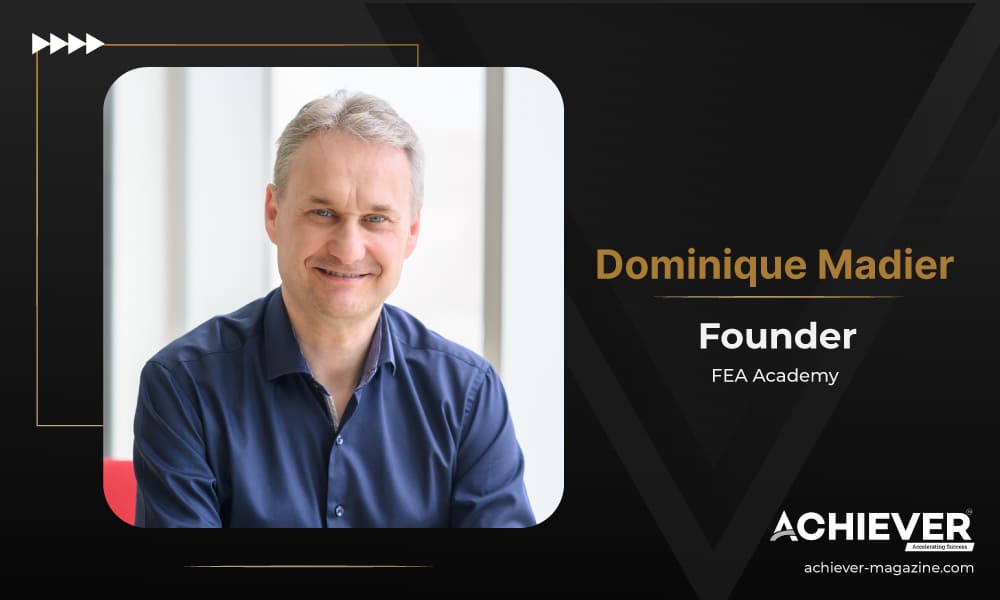
Dominique Madier: Turning Finite Elements into Infinite Possibilities
In the quiet hum of a late-night engineering lab, Dominique Madier found himself staring not at the computer screen filled with complex simulation data, but at the faces of young engineers working beside him, eyes tired, yet filled with determination. It was at that moment he realized that engineering, at its core, was never just about equations or analysis; it was about people, their curiosity, their courage, and their will to create something better.
Years later, that same realization became the foundation of FEA Academy, a place where knowledge is not only taught but shared, where mentorship carries the same weight as mastery, and where every challenge becomes an opportunity to learn and lead.
For Dominique, the goal was never limited to achieving technical precision; it was about nurturing a mindset one that blends passion with purpose and transforms engineers into innovators. “The goal is not only to solve the problem but to empower the client’s team with insights that improve their future projects...” And so the story of FEA Academy continues a story of empowerment, collaboration, and legacy, where competence meets courage, and every engineer who walks through its doors learns to see beyond simulation to the human potential that makes innovation truly possible.
Bridging Theory and Practice
Like many mechanical engineering students, Dominique was first introduced to the fundamentals of the Finite Element Method (FEM) during his university years and from the very beginning, he was captivated by the power of numerical simulation. He quickly recognized that this emerging tool was on the brink of transformative growth and decided to specialize in the field. Through several internships in the aerospace industry, he honed his expertise and deepened his understanding of how digital analysis could revolutionize engineering design.
Dominique’s journey into Finite Element Analysis (FEA) began with a fascination for uncovering how structures behave under stress. Early in his career, he was drawn to the realization that engineering decisions could be validated through digital simulation long before a single prototype was built. The ability to visualize invisible phenomena stress concentrations, deformation patterns, and energy flows through computation was a revelation that shaped his professional path.
Over time, Dominique observed a recurring challenge within the industry: while many engineers were adept at using software tools, few possessed the deeper understanding required to interpret results accurately or connect them to real-world physics. He realized that most training programs focused heavily on technical execution but overlooked the cultivation of true engineering judgment.
This insight became the cornerstone of FEA Academy, an initiative Dominique founded to bridge the gap between theory and practice. His vision was to create a learning environment where engineers wouldn’t just follow tutorials but would grasp the “why” behind every modeling decision. The academy’s philosophy rests on the belief that deep understanding, not just software proficiency, is what fuels innovation and confidence in simulation-driven design.
Building a remote learning model for such a specialized and complex field, however, presented unique challenges. Establishing credibility in a virtual setting, especially for topics involving advanced simulations and intricate engineering discussions, was initially difficult. Many questioned whether highly technical concepts could be effectively taught online.
To counter this skepticism, Dominique designed an interactive, practical, and immersive experience. Each course features live demonstrations, real-world industrial case studies, and personalized feedback sessions. His goal was not to replicate traditional classroom teaching but to elevate it creating an accessible, global platform that maintains depth, rigor, and real-world relevance.
Time zone coordination and cultural diversity added another layer of complexity. With learners joining from across the world, Dominique quickly discovered that enthusiasm for learning transcends geography. The shared curiosity and drive among engineers everywhere transformed logistical challenges into opportunities for collaboration, innovation, and growth.
Through FEA Academy, Dominique continues to empower engineers globally fostering not only technical mastery but also the critical thinking and judgment needed to make simulation a true engine of innovation.
Shaping Engineers Who Think Beyond the Model
Dominique believes that while technical knowledge forms the foundation of engineering, it is the human connection that transforms learning into something truly meaningful. At FEA Academy, this belief guides every aspect of the curriculum. The focus extends beyond what engineers must learn; it emphasizes how they grow as thinkers, problem solvers, and professionals. Each program is designed to nurture curiosity, patience, and confidence, empowering engineers to approach challenges with clarity and resilience.
When learners face complex scenarios such as convergence issues in nonlinear analysis or difficulties interpreting stress gradients Dominique reminds them that these struggles are not setbacks but integral steps in the engineering journey. Lessons extend beyond finding the right solution to understanding the mindset that leads there. Persistence, critical reasoning, and meticulous attention to detail are cultivated alongside technical competence, reinforcing the philosophy that true expertise lies not only in operating software but in thinking like an engineer.
At the heart of FEA Academy’s mission is a commitment to transforming engineers from tool users into analytical thinkers. Mentorship plays a central role, with every participant encouraged to approach projects with purpose, context, and integrity. By guiding learners to think independently and reflect deeply on their methods, Dominique and his team help build engineers who are both technically adept and intellectually self-sustaining. His guiding advice remains simple yet profound: “Think like an engineer first, and a software user second.”
Dominique also emphasizes the contrast between academic idealism and industrial reality. In academia, problems are clean and structured boundaries are precise, materials are uniform, and loads are clearly defined. But in the real world, imperfections, tolerances, and uncertainties are ever-present. To bridge that gap, engineers must develop strong physical intuition and continuously question whether their models mirror real-world behavior. Validation, correlation with tests, and awareness of a model’s limitations are vital to professional credibility.
Those who thrive in industry are the ones who successfully merge theory with practicality. They see beyond simulation outputs and recognize that behind every contour plot lies a real-world structure, a safety consideration, or a product that impacts lives. This awareness that engineering is ultimately a human responsibility is what Dominique instills in every learner at FEA Academy. Through this holistic approach, he continues to shape a new generation of engineers who combine analytical precision with purpose-driven thinking.
Bridging Global Collaboration
Dominique approaches problem-solving with a principle that defines his engineering philosophy: understanding the real question is always the first step. Often, clients present what seems to be a technical issue, but the true challenge lies deeper in clarifying assumptions, defining boundaries, and aligning objectives. Dominique begins every project by listening intently and asking the right questions, ensuring that the engineering goal is well-defined before any model is built or simulation begins.
Once clarity is achieved, he applies a progressive validation approach, starting with simple models that confirm fundamental behavior before advancing to more complex simulations. This systematic progression not only ensures accuracy but also builds trust in both the process and the results. For Dominique, reliability is earned through methodical rigor, not shortcuts.
Collaboration, too, is a cornerstone of his methodology. Rather than simply delivering reports or results, Dominique fosters open dialogue with clients. Together, they interpret findings in the context of design intent, safety, and long-term performance. The goal extends beyond solving the immediate issue; it’s about empowering clients with the insight and confidence to make better engineering decisions in the future.
In the modern era of remote engineering, Dominique has redefined how collaboration works. Structure and discipline underpin every project. Clear milestones, shared responsibilities, and defined review checkpoints keep global teams aligned. Digital platforms enable model reviews and data sharing, but for him, effective communication remains the ultimate tool of success.
He also places a strong emphasis on creating a shared engineering language, a common foundation of modeling standards, documentation, and communication principles that transcend geography. This shared understanding enables efficient, consistent collaboration among engineers from diverse backgrounds and time zones.
Equally important is cultural empathy. Dominique values the diversity that comes from global teamwork, viewing it as a source of creativity and resilience. Different communication styles and technical perspectives enrich discussions, often leading to more innovative, well-rounded solutions. To him, engineering is not just about precision and performance — it’s about connection, understanding, and the collective pursuit of excellence across borders.
How Collaboration and Clarity Drive Engineering Innovation
Dominique describes working with multidisciplinary teams across the globe as one of the most fulfilling dimensions of his career. Finite Element Analysis (FEA), by its very nature, exists at the intersection of multiple engineering disciplines design, materials, manufacturing, and testing making collaboration not just beneficial, but essential. He emphasizes that when experts from these diverse domains engage early and consistently, both the accuracy of simulations and the quality of final products increase exponentially.
For Dominique, collaboration is more than just teamwork; it’s mutual learning in motion. Working alongside materials scientists, aerodynamicists, designers, and manufacturing specialists has expanded his perspective far beyond the analytical realm. Each discipline brings its own way of viewing problems, uncovering insights that would otherwise remain hidden. This exchange of ideas, he believes, is where true engineering innovation happens not in isolation, but through integration and open dialogue.
Global collaboration adds another enriching layer. Engineers from different regions bring distinct technical traditions, methodologies, and problem-solving philosophies. Dominique finds that integrating these varied perspectives leads to more realistic models, better assumptions, and ultimately more resilient designs. These experiences have shaped his conviction that the best engineering outcomes arise when experts are united by curiosity, humility, and a shared commitment to learning from one another.
Writing became a natural continuation of Dominique’s work as both an engineer and an educator. He often says that “clarity is one of the greatest forms of generosity.” Engineering, and FEA in particular, can appear intimidating to those new to the field. By translating complex concepts into clear, applicable insights, he seeks to make advanced simulation more approachable. His goal has always been to demystify FEA, helping engineers not just learn commands but develop engineering instincts the kind that blend theoretical understanding with real-world practicality.
Dominique’s publications focus on the practical challenges engineers face daily: interpreting unexpected results, refining meshes correctly, defining contact accurately, or selecting the right element type. These seemingly small details often define the success or failure of an analysis. Drawing from his own early-career mistakes, he writes to save others from the same frustrations, turning personal lessons into professional guidance.
The greatest reward for him, however, comes from connection. When readers share that his writing helped a concept “click” or gave them confidence to solve a problem differently, Dominique finds validation in knowing his words made a tangible impact. For him, writing is both a reflection of his passion and a tool for collective growth, a way to strengthen the global engineering community, one clear explanation at a time.
Empowering the Next Generation
Dominique speaks with deep pride about one of the most meaningful dimensions of his work, the mentoring programs at FEA Academy, which have evolved into one of its most successful and impactful pillars. For him, few achievements rival the satisfaction of seeing engineers grow in confidence, capability, and leadership through guided mentorship.
The mentoring initiative pairs seasoned FEA professionals with early-career engineers from across the globe, focusing not just on technical development but also on cultivating the right mindset, communication skills, and problem-solving habits. The results have been transformative. Many mentees have advanced from hesitant beginners to confident leaders managing complex structural simulation projects. Some have gone on to establish their own consulting practices or assume senior engineering roles, a testament to the depth and effectiveness of this personalized approach.
What sets the program apart is its individualized, hands-on structure. Every mentoring journey is tailored to the mentee’s background, strengths, and professional aspirations. Mentors and mentees work together on real-world engineering projects, exploring technical decision-making through the lens of engineering judgment rather than software operation. This fosters a deeper connection, a partnership built on mutual respect, trust, and shared goals. For Dominique, this human connection is what transforms mentoring from education into empowerment.
Beyond mentoring, Dominique has also been instrumental in growing FEA Academy’s digital outreach. The FEA Mastery YouTube Channel and FEA Journeys Podcast have become global platforms for knowledge-sharing and inspiration. These channels feature insights from leading engineers, educators, and innovators who bring the world of simulation to life through real stories of perseverance, discovery, and creativity. By highlighting the human stories behind technical achievements, these platforms bridge the gap between theory and lived experience.
Simultaneously, the FEA Experts consulting division continues to expand, offering companies without internal FEA resources access to advanced simulation expertise. This model eliminates the barriers of software cost and full-time staffing, while feeding real-world challenges back into FEA Academy’s curriculum creating a powerful cycle of continuous learning and improvement.
Ultimately, all of these efforts mentoring, training, and consulting align under a single vision: to elevate the global standard of FEA practice while building a connected, supportive engineering community. The mentoring program, in particular, stands as the heart of that mission. For Dominique, the most rewarding moment is seeing former mentees return as mentors, ready to guide the next generation. In that moment, the vision of FEA Academy transcends education; it becomes a living legacy, a global movement of engineers dedicated to lifelong learning, leadership, and shared excellence.
Inspiring Confidence, Courage, and Continuous Learning
Dominique envisions a legacy defined not by accolades or simulations, but by confidence, curiosity, and collaboration. His goal is to inspire young engineers to view Finite Element Analysis (FEA) not merely as a technical skillset but as a way of thinking, a blend of creativity, scientific reasoning, and problem-solving discipline. He hopes they will see themselves as the bridge between innovation and safety, the ones who ensure that ideas take shape responsibly and effectively.
For Dominique, the true success of FEA Academy lies in its impact on people, not just projects. If future generations remember the Academy as the place where they gained not only competence but also the courage to question, explore, and innovate, then his purpose will have been fulfilled. His vision extends beyond technical mastery; he aspires to nurture empowered engineers who, in turn, mentor others and carry forward a cycle of growth and knowledge-sharing.
He often reminds emerging professionals that while technologies evolve, the essence of good engineering endures. Mastering fundamentals, staying curious, and maintaining adaptability are what truly sustain a successful career. He encourages engineers to seek out mentors, take on challenging projects, and approach every obstacle as an opportunity to deepen understanding. A truly global career, he emphasizes, is built as much on relationships and humility as it is on technical expertise.
At its heart, Dominique’s philosophy reflects a deep respect for the human side of progress. He believes that while tools and technologies may change rapidly, what defines true advancement is our willingness to share knowledge and elevate one another. This belief forms the cornerstone of FEA Academy education and mentorship as engines of transformation, shaping not only industries but entire communities of engineers who learn, lead, and grow together.
For Dominique, the future of engineering will not be shaped by tools alone but by the people who wield them with passion, purpose, and integrity. His enduring message is simple yet powerful: “Innovation thrives where knowledge is shared, curiosity is encouraged, and people support one another.”


