
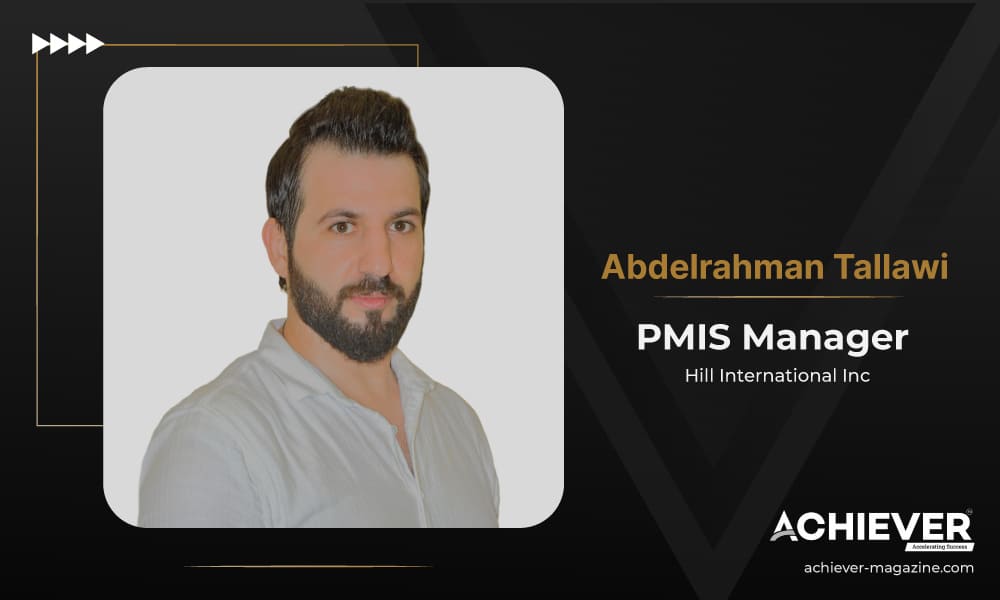
Abdel Rahman Tallawi: Designing Intelligence for the Projects That Shape Tomorrow
Before dashboards, reports, or systems ever come online, there is uncertainty competing priorities, fragmented data, tight deadlines, and people carrying invisible pressure. Projects rarely fail because of a lack of tools; they fail when risks are seen too late, signals are missed, or teams aren’t aligned. True project intelligence begins long before implementation, with the ability to anticipate where things may break and prepare for it technically, operationally, and emotionally.
This belief has shaped the career of Abdel Rahman Tallawi, PMIS Manager at Hill International Inc., whose work sits at the intersection of systems, strategy, and human reality. He approaches Project Management Information Systems not as software deployments, but as living ecosystems that must serve everyone involved from field engineers navigating day-to-day execution to executives making time-critical decisions.
With more than 13 years of experience and over 50 projects delivered across contracting, technology, and real estate development, Abdel Rahman has built a reputation for making complex programs more predictable and resilient. His progression into the role of Head of System Intelligence reflects a focus on integrating data, reporting, and analytics to enable real-time insight and early risk detection.
Grounded in advanced academic training, including an MPhil from Spain, a master’s in project management, an MBA in Business Administration from the United Kingdom, and an Extended Diploma in International Business and Strategy from Scotland, he understands that digital tools are no longer optional. They are essential, but only when governed thoughtfully and implemented with foresight.
For Abdel Rahman, effective PMIS is not about systems alone. It is about clarity, alignment, and enabling people to perform at their best under pressure.
From Software Engineering to Strategic PMIS Leadership
Abdel Rahman began his career with a bachelor’s degree in computer science, which led him into software development, where he worked on enterprise solutions and back-end systems designed to automate critical business processes. While he valued the technical depth of coding and problem-solving, he soon became interested in how systems could be applied beyond products to manage complex, large-scale projects. This curiosity marked a defining shift in his professional path.
He transitioned into a project coordinator role, supporting delivery teams and helping bridge the gap between technology and operations. From there, Abdel Rahman advanced to become Head of System Intelligence, where he led initiatives centered on data integration, reporting, and analytics to enable real-time, informed decision-making. These roles laid the groundwork for his move into Project Management Information Systems (PMIS), allowing him to combine technical expertise, business acumen, and project management discipline.
Over more than 13 years, Abdel Rahman Tallawi has contributed to over 50 projects across sectors, including contracting, technology, and real estate development. Alongside his professional experience, he pursued advanced academic qualifications, earning an MPhil from Spain, a master’s in project management, and an MBA in Business Administration from the United Kingdom, as well as an Extended Diploma in International Business and Strategy from Scotland. These studies strengthened his strategic perspective and his ability to align digital transformation initiatives with organizational objectives.
Currently, Abdel Rahman serves as a PMIS Manager and doctoral researcher pursuing a Doctor of Business Administration (DBA), with a research focus on the digitalization of project environments. His career reflects a commitment to continuous learning, blending practical implementation with academic research.
At Hill International, a global leader in project and construction management, Abdel Rahman found an environment that aligns with his belief in PMIS as a strategic asset rather than a supporting tool. Since joining the firm, he has led the implementation and customization of PMIS platforms for complex projects, gradually expanding his scope to include strategic oversight, data governance, performance analytics, and stakeholder engagement. Today, he leads cross-functional teams, drives PMIS standardization, collaborates closely with clients, and contributes to shaping Hill International’s regional digital strategy while mentoring emerging professionals in the field.
Turning Project Data into Insight, Control, and Confidence
A PMIS Manager serves as the digital backbone of modern project delivery, ensuring that project information is accurate, timely, accessible, and actionable. The role centers on designing, implementing, and managing integrated systems that capture real-time data across cost, schedule, risk, procurement, and reporting functions, enabling informed decision-making throughout the project lifecycle.
In today’s infrastructure and construction environment, the responsibilities of a PMIS Manager extend far beyond system administration. The role has evolved into one of strategic enablement, facilitating communication, promoting transparency, and safeguarding compliance. By transforming raw data into meaningful insights, PMIS Managers support executive leadership with reliable forecasting, performance visibility, and early risk identification embedded within the system architecture.
The value of effective PMIS deployment is measurable. Well-implemented systems lead to greater project predictability, earlier risk detection, stronger stakeholder engagement, and more efficient collaboration across teams. In an industry often challenged by delays and cost overruns, a robust PMIS can be a decisive factor in achieving successful outcomes.
Recent years have marked a significant shift in how organizations view digital project tools. PMIS has transitioned from being a supplementary reporting solution to a foundational element of project governance. Cloud-based platforms, mobile applications, and real-time dashboards are no longer optional they are essential components of modern project execution.
A key advancement has been the integration of PMIS with enterprise systems such as ERP, BIM, document management, and procurement platforms. This integration has enabled centralized digital ecosystems that eliminate data silos and establish a single, trusted source of information. Additionally, the growing use of data visualization, predictive analytics, and remote collaboration tools has further enhanced transparency, foresight, and responsiveness across project teams, accelerating the industry’s broader digital transformation.
Cutting Through the Hype with Data-Driven Project Intelligence
Abdel Rahman views artificial intelligence and automation through a practical lens. While he recognizes their long-term potential, he believes the greatest value today lies in data-driven solutions that deliver immediate improvements in project visibility and reduce manual inefficiencies. For him, technology must solve real operational problems rather than exist as innovation for its own sake.
He points to automated workflows for approvals, RFIs, and submittals as examples of tools that create tangible benefits by saving time and minimizing human error. Predictive analytics, when built on reliable historical data, can help flag potential cost overruns or schedule delays before they escalate. Even straightforward features, such as automated notifications for document reviews, can significantly enhance productivity and accountability across project teams.
At the same time, Abdel Rahman remains cautious about emerging technologies that have yet to mature. He sees considerable hype surrounding concepts such as blockchain and fully realized digital twins, noting that their adoption in construction remains constrained by high implementation costs, limited standardization, and steep learning curves. In his view, successful digital transformation depends on prioritizing solutions that integrate smoothly with existing workflows, are intuitive for users, and deliver measurable returns within a project’s lifecycle.
Abdel Rahman’s leadership style is rooted in accountability, clarity, and empathy. He believes that during high-pressure situations, teams need focus and direction rather than added complexity. By providing structure, transparent communication, and decisive action, he strives to be a stabilizing presence. Equally important to him is continuous learning, encouraging feedback, reflection, and improvement to build resilient systems and empowered teams.
Leading Change, Alignment, and Resilience in Complex Project Environments
Abdel Rahman identifies resistance to change as one of the most significant challenges in PMIS implementation. Many organizations and individuals remain comfortable with legacy tools such as spreadsheets, email-based workflows, and disconnected documentation. Moving stakeholders toward integrated digital platforms requires more than a technical rollout it demands a deliberate cultural shift that reshapes how teams think about data, accountability, and collaboration.
Another major challenge lies in alignment. Large-scale projects often involve multiple contractors, consultants, and clients, each operating with different systems, standards, and expectations. Harmonizing data across these stakeholders requires strong governance, early engagement, and clear agreement on data definitions and workflows. Without this foundation, even the most advanced PMIS platforms risk underperforming or failing altogether.
Training and user adoption present an additional hurdle. When users do not fully understand how to interact with the system or fail to see its value, utilization suffers. For this reason, Abdel Rahman emphasizes change management, structured onboarding, and continuous support as critical components of any successful PMIS deployment.
In high-pressure situations, Abdel Rahman relies on three guiding principles: foresight, adaptability, and collaboration. Foresight involves planning not only from a technical perspective, but also operationally and emotionally, anticipating potential pain points and addressing them early. Adaptability focuses on responding calmly and effectively when challenges arise, particularly during technology-related disruptions. Rather than reacting impulsively, the approach is to assess, communicate, and execute with clear priorities. Finally, collaboration remains central open dialogue, shared ownership, and collective problem-solving foster faster recovery, stronger morale, and more resilient project teams.
Building the Next Generation of Intelligent Project Ecosystems
Abdel Rahman believes the next generation of PMIS professionals must adopt a hybrid mindset one that balances technical expertise, analytical capability, and strategic thinking. Understanding how systems function is no longer enough; future leaders must also grasp why those systems matter in the broader context of project outcomes and organizational performance.
He emphasizes that critical competencies will include data analytics, systems integration, and digital transformation strategy. Equally important, however, are soft skills such as communication, change management, and user-centered design. PMIS professionals sit at the intersection of technology and people, and success depends on the ability to translate complex technical concepts into practical, user-friendly solutions that drive adoption and trust.
A growth mindset, in his view, is non-negotiable. As tools, platforms, and methodologies continue to evolve, PMIS professionals must commit to lifelong learning and remain adaptable to shifting industry and organizational demands.
At Hill International, Abdel Rahman’s vision is to develop a unified, intelligent project ecosystem that supports informed decision-making across all project phases and evolves in line with client needs. He sees PMIS moving beyond traditional reporting to become a strategic enabler, one that supports predictive forecasting, scenario planning, and enterprise-level insights.
More broadly, Abdel Rahman believes PMIS will play a pivotal role in the digital future of infrastructure delivery. As projects become larger and more complex, the ability to coordinate stakeholders, manage risk, and optimize performance through data will be essential. He also advocates for stronger collaboration between academia and industry, leveraging research-driven insights to advance PMIS practice and contribute to a more intelligent and sustainable construction sector.


