
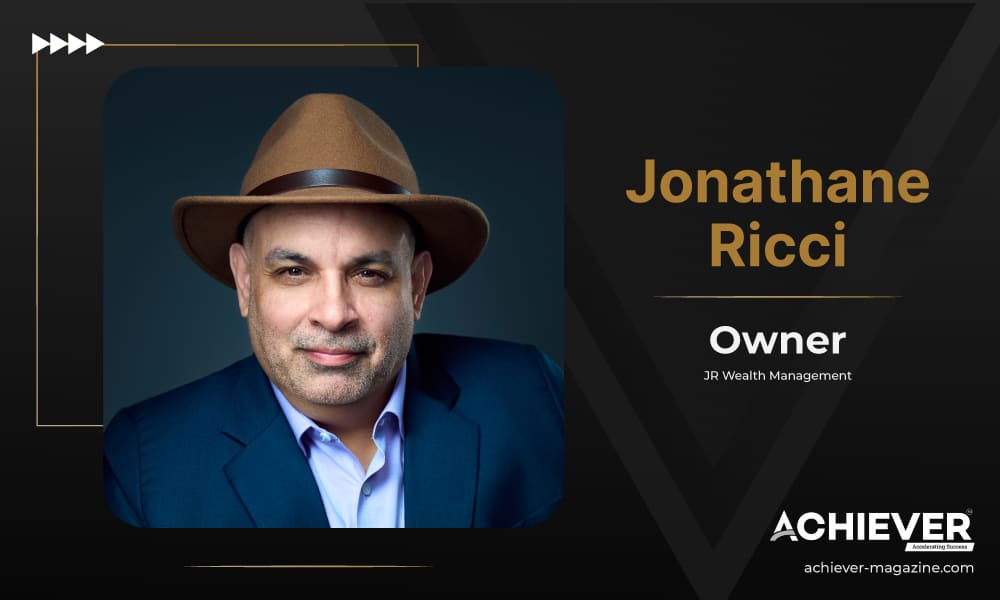
Jonathane Ricci: Leading with Perspective, Purpose, and Resilience
Some leadership lessons are learned through success. Others are earned through adversity, uncertainty, and decisions where there is no obvious answer. For Jonathane Ricci, Owner of JR Wealth Management, decades spent working across law, international business, taxation, wealth management, and strategic advisory have provided both. His journey has taught him that leadership is less about having all the answers and more about having the judgment to move forward, the humility to listen, and the resilience to remain steady when circumstances change.
Ricci’s understanding of leadership has evolved with experience. Earlier in his career, he viewed leadership largely through the lens of decisiveness, control, and maintaining a clear direction. Over time, he came to understand that these qualities are only part of the equation. Effective leadership also requires adaptability, communication, trust, and the ability to empower capable people. For Ricci, a leader must establish the objective and standards, bring together the right expertise, and then give people room to contribute and perform. The true test of that philosophy, he believes, comes when conditions become difficult. When uncertainty and pressure enter the picture, people look to their leaders for stability.
That perspective is reflected in the way he has developed JR Wealth Management. Rather than building the firm around a single product or conventional advisory category, Ricci sought to create a broader strategic resource for clients whose financial and business affairs often extend across multiple areas. Taxation, corporate structuring, estate planning, asset protection, investments, business interests, and international considerations can be closely connected, and addressing one without understanding the others can leave important questions unanswered. JR Wealth Management was therefore shaped around a multidisciplinary approach that identifies the larger picture, develops an overall strategy, and coordinates with qualified professionals when specialized expertise is required.
The international dimension has also become increasingly important. Entrepreneurs, families, and businesses are operating across jurisdictions more frequently, while decisions involving residency, investments, business structures, succession, and wealth preservation can have implications well beyond one country. Ricci believes an effective wealth strategy must account for that complexity. At the same time, he has remained committed to something much simpler: building relationships for the long term. Rather than focusing on a single transaction or immediate objective, he prefers to understand where a client wants to be five, ten, or twenty years from now and help build toward that destination.
Trust That Endures Beyond the Transaction
For Ricci, the foundation of that approach is trust. Confidentiality, loyalty, accountability, and discretion are principles he considers non-negotiable. Clients often share much more than financial information. They share their ambitions, family circumstances, business challenges, concerns, and plans for the future. With that comes a responsibility to be candid, even when the advice may not be what someone wants to hear.
Ricci believes a difficult conversation today can prevent a much larger problem tomorrow. He also views loyalty as something that becomes most meaningful when circumstances are challenging. Relationships are not truly tested when everything is going well; they are tested when uncertainty emerges and a client needs someone willing to remain engaged, composed, and committed to the larger objective.
His years of client experience have also changed the way he thinks about wealth itself. Financial success is not defined in the same way for everyone. For one person, it may mean building a business. For another, it may mean protecting a family, achieving financial independence, preserving wealth across generations, or gaining the freedom to make choices about how and where to live.
That understanding has led Ricci to look beyond accumulation alone. Preservation, taxation, succession, liquidity, risk, and purpose all matter when building a meaningful financial strategy. Ultimately, he sees wealth as a tool for creating security, opportunity, and freedom. The objective is not simply to reach a particular number, but to create a financial structure that supports the life a person wants to live and protects what they have worked to build.
The Judgment to Move Forward
Uncertainty is unavoidable in leadership, particularly when decisions carry significant financial, business, or personal consequences. Ricci approaches high-stakes situations by first creating space for disciplined analysis. He wants to understand the facts, distinguish what is known from what remains uncertain, identify genuine risks, and separate those risks from assumptions or emotion. When specialized knowledge is necessary, he believes the right response is to bring the appropriate expertise into the conversation.
Yet analysis cannot continue indefinitely. At some point, a leader has to act without the benefit of perfect information. Ricci considers the immediate consequences of a decision, but also looks further ahead: What happens next? What could go wrong? What alternatives remain if circumstances change? This focus on second- and third-order effects allows him to approach uncertainty as something to be managed rather than something that should prevent action.
He describes the relationship between strategy and execution simply: “strategy is the compass and execution is the journey”. The long-term objective should guide today’s decisions, while today’s responsibilities should never be neglected in pursuit of tomorrow’s ambitions. Delegation is part of that balance. Leadership, in his view, is not about controlling every decision personally. It is about setting clear standards, assembling capable professionals, and recognizing when someone else’s expertise can make the outcome stronger.
That disciplined approach is also shaping how he views the future of wealth management. The industry is becoming broader, more global, and more interconnected, with clients increasingly navigating businesses, real estate, private investments, multiple jurisdictions, changing residency, succession, taxation, asset protection, and digital assets. Ricci sees an opportunity for leaders who are willing to challenge traditional models and help clients understand how these different elements fit together.
Technology and artificial intelligence will be an important part of that evolution. Ricci believes AI can enhance research, analysis, communication, and the ability to evaluate alternatives, but he does not see technology replacing judgment or human relationships. In fact, as information becomes easier to generate and automate, trust, discretion, context, and sound judgment may become even more valuable. For him, the future of wealth management is not simply about managing money. It is about helping people manage complexity, anticipate change, and structure their financial lives around where they want to go next.
From Achievement to Impact
Perhaps the most revealing part of Ricci’s leadership philosophy is the distinction he makes between success and lasting impact. Success can be measured through business growth, professional recognition, financial achievement, or reaching personal goals. Impact is measured differently. It is found in what those achievements enable other people to accomplish.
That impact may come through helping a client protect what they have built, offering advice that changes the direction of a business, helping a family create greater security for the next generation, or sharing knowledge that allows someone else to avoid a mistake. Some of the most meaningful moments, Ricci believes, may never appear on a résumé.
“Ultimately, success is largely about what you achieve. Impact is about what your achievements enable others to achieve.”
That philosophy provides a natural direction for the next chapter of his career. Ricci wants to continue developing JR Wealth Management into an increasingly global and forward-thinking organization that can help clients navigate a rapidly changing financial landscape without losing the personal relationships on which the firm was built. He also wants to share more of the knowledge accumulated through decades in law, business, taxation, and wealth planning with clients, entrepreneurs, younger professionals, and others who can benefit from those experiences.
The legacy he hopes to leave is therefore not defined simply by financial results or the size of a business. He wants to be remembered as someone who thought independently, remained resilient through adversity, protected the people who placed their trust in him, and used his experience to help others recognize opportunities, make better decisions, and build something lasting.
For Jonathane Ricci, leadership is ultimately measured by what remains after the decision has been made and the achievement has been reached. It lives in the trust earned over time, the people helped along the way, and the opportunities created for those who follow. As he looks toward the next chapter of JR Wealth Management, his focus remains firmly on that larger purpose: continuing to evolve, sharing what experience has taught him, and creating value that extends beyond his own career. In that sense, the next chapter is not simply about achieving more. It is about making what has already been built matter for longer.


