
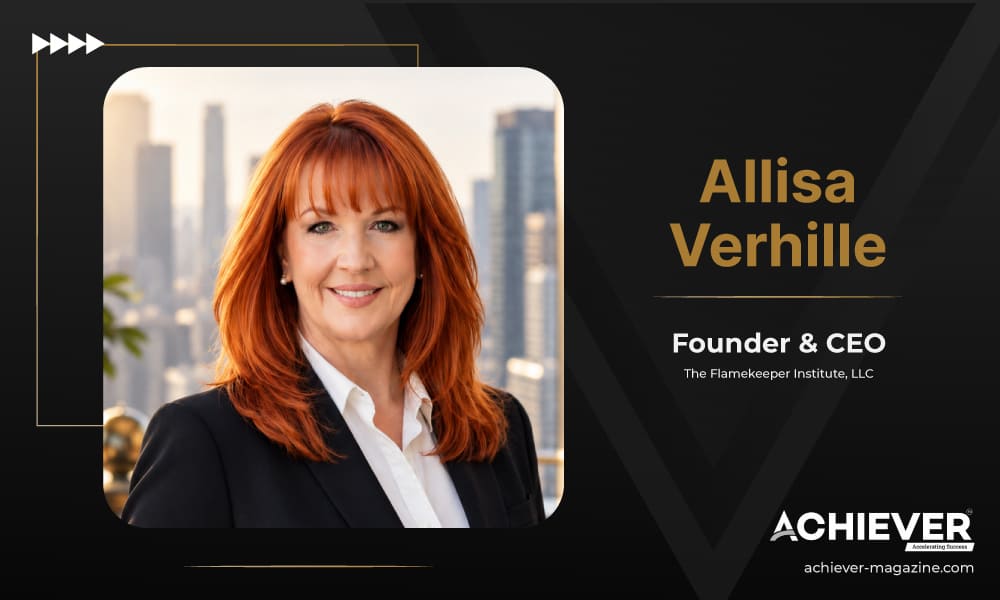
Allisa Verhille: Where the Human Being, Leadership, and Organizational System Meet
Looking Beyond the Problem to Find What Really Needs to Change
A leader can be successful and still be exhausted. An organization can be growing and still be struggling. A high-performing executive can appear confident while quietly questioning whether the identity that built their career is still capable of carrying them into its next chapter. For Allisa Verhille, these contradictions are not unusual. They are often where the most important leadership conversations begin.
With more than 25 years of experience across technology, PMO leadership, governance, business transformation, executive management, coaching, speaking, and writing, Verhille has spent her career working where strategy meets reality. She has experienced the competing priorities, risk, resistance, accountability, and execution challenges that accompany transformation. Over time, one lesson became increasingly clear: the visible problem is rarely the whole problem. A performance issue may actually be a decision-rights problem. Burnout may have less to do with workload than with identity. An executive may be compensating for an organizational system that no longer works.
That understanding became the foundation for The Flamekeeper Institute™, which Verhille founded not as a larger coaching practice, but as a leadership transformation and organizational performance institute. The Institute works at the intersection of the human being, leadership, and the organizational system. Its work spans executive advisory, Leadership Intensives, organizational transformation, leadership development, thought leadership, speaking, publishing, and proprietary leadership frameworks. The philosophy connecting these areas is simple: diagnose before prescribing, understand the whole picture, and turn insight into sustainable change. The Institute can work alongside leaders to strategize, build, and implement what needs to change.
A Corporate Career That Taught Her to Respect Execution
Verhille’s approach to leadership cannot be separated from her corporate experience. Her career across technology, organizational change, digital transformation, program management, governance, and executive leadership exposed her to the realities that sit behind strategic presentations and transformation roadmaps. Priorities compete. Stakeholders disagree. Risks emerge unexpectedly. Teams must keep the business running while simultaneously being asked to change it. Leaders have to make decisions even when complete information is unavailable.
Those experiences shaped a practical dimension of her leadership and transformation philosophy. Insight matters, but Verhille consistently asks a more demanding question: “What changes because we discovered this?” A meaningful conversation about leadership cannot stop at awareness. If a leader recognizes a pattern but continues operating exactly as before, the insight has not yet become transformation. This belief has led her to combine the human side of leadership with the operational realities of organizations.
That combination allows Verhille to move comfortably between conversations about identity, pressure, and behavior and questions about governance, accountability, decision rights, stakeholder alignment, and implementation. She does not see those as separate conversations. Human behavior influences systems, while systems influence human behavior. Understanding one without the other can result in solutions that address symptoms while leaving the underlying pattern untouched. Her corporate background therefore remains an important part of what makes her approach practical: she understands that a strong idea must ultimately survive contact with the real world. Sometimes the leader needs to change. Sometimes the system needs to change. Usually, we need to understand both.
The Flamekeeper Institute™: More Than Executive Coaching
The Flamekeeper Institute was born from Verhille’s desire to create a leadership transformation and organizational performance institute for critical inflection points. These are the moments when something is no longer working, when an organization has outgrown the way it operates, or when a leader recognizes that the methods that created previous success may not be enough for what comes next.
The Institute’s work is intentionally broad. Executive advisory, organizational transformation, founder advisory, executive education, research, publishing, speaking, strategic partnerships, and Leadership Intensives form different pathways into the same larger body of work. Organizations often come to The Flamekeeper Institute knowing something is not working, while the symptoms appear in different places. A Leadership Intensive uncovers the pattern beneath those symptoms—across leadership behavior, decision-making, accountability, culture, strategy, and execution—and determines what actually needs to change. The Institute then works alongside leaders to translate diagnosis into ownership, action, and implementation.
For Verhille, the distinction between a practice and an institution is important. If The Flamekeeper Institute succeeds only when she is personally in the room, she believes she has built a practice. If the ideas can be taught, tested, challenged, and carried into rooms she may never enter, then something larger has been created. That ambition is reflected in the way she thinks about her intellectual property and thought leadership. The goal is not simply to provide services, but to develop ideas that can continue creating value beyond an individual engagement.
The Flame Spiral™ and the Nonlinear Nature of Transformation
One of Verhille’s proprietary frameworks, The Flame Spiral™, emerged from her recognition that transformation is rarely linear. People often imagine growth as a ladder, where each achievement represents a permanent step upward. Leadership and life are more complicated. A person may master courage in one season and discover that a completely different form of courage is required later. A previous success may eventually require reinvention. Greater responsibility may force someone to reconsider identity.
The Flame Spiral™ provides an architecture for this evolution through twelve interconnected elements: Ignition, Empowerment, Resilience, Courage, Transformation, Leadership, Alignment, Reinvention, Wisdom, Legacy, Connection, and Eternal Impact. Rather than simply asking a leader what skill they need to acquire, the framework encourages a more fundamental question: what is this particular threshold requiring from me now?
That shift can change the conversation. Is the issue really confidence, or is it courage? Is exhaustion the result of workload, or is it misalignment? Is another goal genuinely needed, or has the leader reached a point where reinvention is necessary? The framework helps leaders locate themselves more honestly and recognize that returning to an old question does not necessarily mean they failed to learn the lesson. Sometimes it means they are ready to answer it differently at a new stage of leadership and life.
When Achievement Becomes an Identity
High-achieving executives are often rewarded for carrying more. They become the dependable person, the calm person, the person who can solve difficult problems when everyone else is uncertain. Over time, those strengths can become deeply connected to identity. The leader who is always available may struggle to step back. The executive who has built a reputation for certainty may find it difficult to admit uncertainty. The problem-solver may begin taking responsibility for problems that should belong to the wider organization.
Verhille calls attention to this pattern through Identity Exhaustion™, a concept that examines the hidden cost of maintaining the version of oneself that everyone has learned to depend upon. Importantly, this exhaustion can exist even when performance remains strong. A leader may continue meeting expectations while privately feeling depleted by the constant requirement to be capable, composed, certain, and needed.
Her approach is not to help accomplished people become better at enduring the same cycle. Instead, she encourages them to examine what their experience is telling them. What responsibilities genuinely belong to them? What are they doing because it matters, and what are they doing because being indispensable has become part of their sense of value? Verhille believes sustainable success should expand a leader’s capacity without requiring their disappearance. The objective is not to lower standards, but to build a way of leading that remains human enough to sustain them.
Resilience Is More Than Endurance
Verhille makes a deliberate distinction between endurance and resilience. Endurance asks, “How much more can I take?” Resilience asks, “What is this teaching me about how I need to lead differently?” For executives working under sustained pressure, that distinction can be significant. The ability to tolerate difficult circumstances does not necessarily mean that the underlying way of operating is healthy or effective.
Her concept of Pressure Intelligence™ explores what happens when the stakes rise. Some leaders become controlling. Others withdraw, avoid difficult conversations, become reactive, or narrow the circle of people they trust. Some begin overfunctioning, taking on responsibilities that should be distributed across the organization. These reactions are not merely personal habits. Under pressure, they can influence teams, decision-making, communication, and organizational culture.
Verhille’s approach therefore begins with diagnosis and moves toward choice. Leaders examine what they are carrying, what they are tolerating, and where identity has become fused with title, performance, or being needed. Sustainable leadership does not mean creating a pressure-free environment or making demanding work comfortable. It means developing the discernment, boundaries, recovery, and self-awareness required to meet high standards repeatedly without turning depletion into a permanent operating model.
Leadership When Everything Feels Urgent
The leadership environment is changing rapidly. Artificial intelligence, workforce shifts, uncertainty, and unprecedented volumes of information are reshaping how organizations operate and how executives make decisions. In this environment, Verhille believes organizations need to become more thoughtful about the difference between speed and effectiveness. Moving faster is not automatically progress if clarity is missing.
One question she believes organizations need to confront is whether truth can travel upward. Can someone challenge an assumption before it becomes an expensive mistake? Can a team say that a priority is unclear? Can senior leaders hear information they do not want to hear without unintentionally creating a culture where people stop bringing it? These questions have implications far beyond culture. They influence risk, innovation, accountability, strategic decision-making, and the organization’s ability to adapt.
Verhille also believes that as technology becomes more capable, human judgment becomes more important rather than less. AI can support analysis, accelerate processes, and change how work gets done, but accountability cannot simply be transferred to a tool. Organizations need leaders who can distinguish signal from noise, think clearly through ambiguity, invite constructive dissent, and create clarity when everything appears urgent. In her view, the most important leadership technology remains the human being.
From Thought Leadership to a Body of Work
Verhille’s work extends beyond private executive conversations. As a Master Certified Executive Coach, Keynote and Motivational Speaker, and author of The Fire Within™ Series, she is building a body of work designed to travel through different formats and reach people at different points in their leadership journeys. Her speaking engagements, including work connected with institutions such as Oxford and Columbia, have reinforced her belief that thought leadership must be useful beyond the stage.
Speaking, for Verhille, is not simply about delivering an impressive presentation. It is an opportunity to test whether an idea can become understandable, memorable, and practical for people facing real decisions. A concept becomes meaningful when it can leave the auditorium and influence a conversation, a leadership choice, or a behavior after the event has ended.
The same philosophy informs the relationship between executive education, publishing, advisory work, Leadership Intensives, and the Institute’s proprietary frameworks. Each serves a different purpose, but they are connected by the same underlying ideas about identity, pressure, systems, leadership, and responsible performance. Verhille sees these activities not as a collection of unrelated services, but as an ecosystem through which ideas can move from reflection to application and, ultimately, into sustained organizational change.
The Fire Within™: Reconnecting with Who We Are Becoming
The Fire Within™ Series brings a deeply personal dimension to Verhille’s work. Its central question emerged from experiences that challenged her personally and professionally: what remains when the version of you that got you this far can no longer take you where you need to go? Her experiences with teenage cancer, physical rebuilding, professional reinvention, and beginning again have influenced the way she understands transformation.
For Verhille, transformation is not always about recovering a former self. Sometimes it is about meeting the person one is becoming. That idea has particular relevance for accomplished leaders who have spent years building careers around responsibility, performance, achievement, and being needed. At certain points, the next chapter may require them to question not only what they are doing, but who they believe they need to be in order to succeed.
That message is at the heart of The Fire Within™ Series: the fire within a person is not necessarily gone because responsibility, disappointment, survival, or success has covered it. Leaders can remember what matters, make different choices, and move forward without recreating an older version of themselves. For Verhille, leadership can never be completely separated from the human being doing the leading. The work of transformation therefore begins not simply with what leaders do, but with how they understand themselves.
A Legacy Designed to Outlive the Room
Looking ahead, Verhille sees The Flamekeeper Institute becoming a broader platform for leadership transformation, bringing together executive education, Leadership Intensives, organizational transformation, founder advisory, research, publishing, speaking, and strategic partnerships. Her ambition is not simply to expand the services offered by the Institute, but to build a body of work that can continue to create value long after a keynote has ended or an engagement has concluded. She wants its frameworks to be taught, questioned, tested, and strengthened, allowing the ideas to travel into organizations and leadership conversations far beyond her own presence.
That same philosophy shapes her vision for The Fire Within™ Series. The books, frameworks, and conversations are intended to meet people at different thresholds of leadership and life, reminding them that transformation does not always mean returning to who they once were. Sometimes it means having the courage to become someone new. For leaders especially, that can mean recognizing when an old definition of success has reached its limit, understanding what pressure is revealing, and creating enough space to choose what comes next with greater clarity and intention.
Being recognized among the “World’s Top 10 Executive Coaches to Follow in 2026” is a meaningful milestone in that journey, but Verhille’s ambitions extend beyond recognition. Her measure of success is ultimately what happens after the recognition, after the keynote, and after the coaching conversation: whether a leader finally names what has been holding them back, whether an executive makes a more conscious decision, or whether an organization becomes willing to address what it has been avoiding. Her work is built on the belief that real transformation begins when insight becomes action and continues when that action creates lasting change. In the end, Verhille is not simply building a coaching practice or personal brand. She is building an enduring body of work designed to develop stronger leaders, healthier organizations, and better decisions—and change that continues long after The Flamekeeper Institute has left the room.


